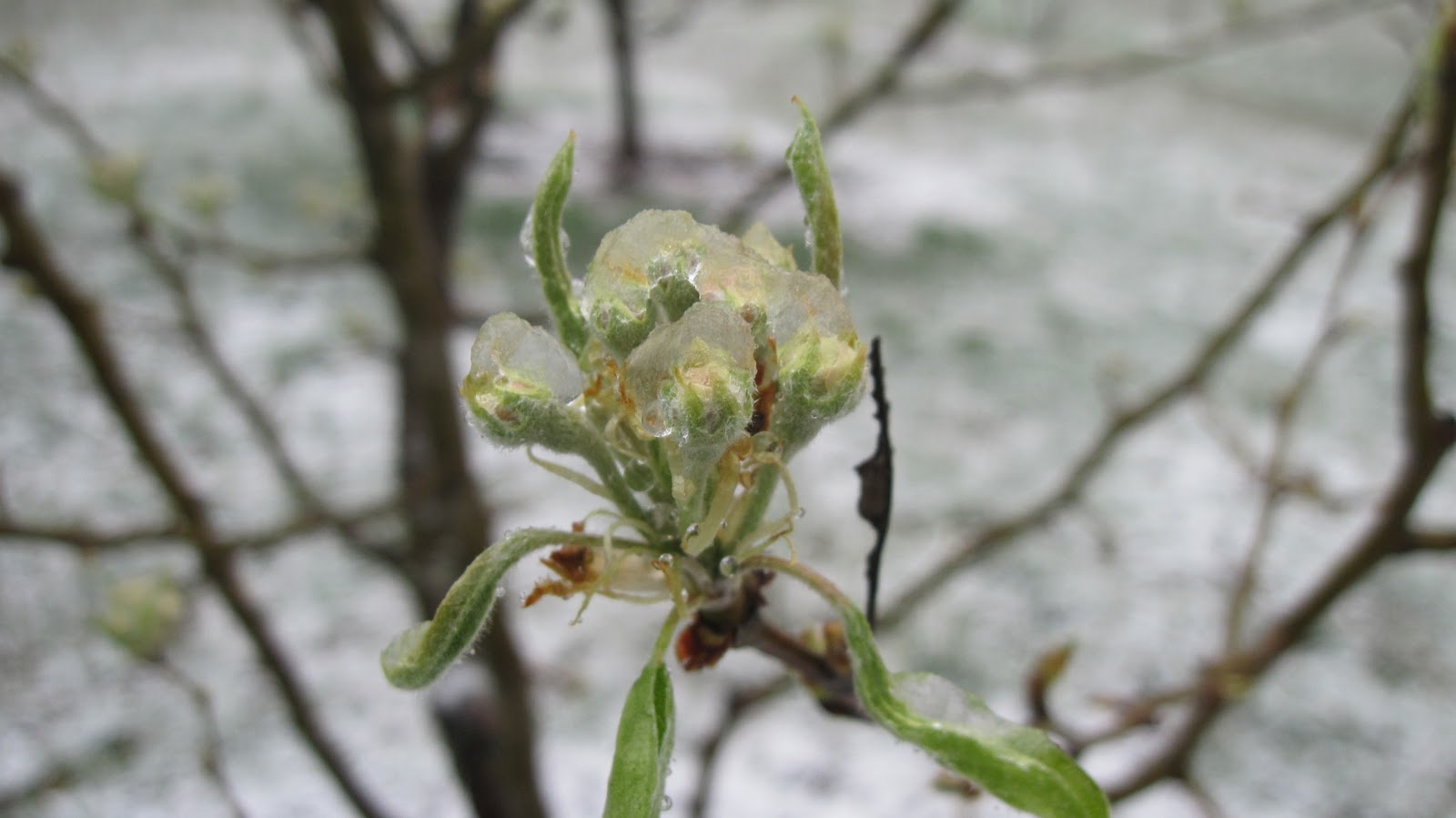
"How're ya doin,' pear?"
A "spring garden" here in Virginia, where we often experience frosts through the end of April, refers to flowers and vegetables that are "hardy" or "moderately hardy." These plants don't mind getting cold. Temperatures in the 20s won't cause ice to fill their cells and collapse their cell walls. (Please, if you would, correct me regarding the chemistry and physiology.)
Another set of plants might be called "winter garden" plants because they put up with pretty much any low temperatures that come their way, such as the garlic we plant in November. Plant garlic in the spring and you can count on waiting through the next winter before it fully matures. When we plant garlic in November, we usually don't see much above-ground growth until spring, but I understand the roots are busy underneath, which of course is what most of us like to eat.
"Like oaks and maples and locusts," says Virginia.
Smarty pants. Maybe I should have defined "garden."
Let's look at the hardy vegetables. We have a Swiss chard plant that's been growing for 4 years, although this year it seems to have pretty well petered out. Other plants thriving from last season include spinach, Chinese cabbage, arugula, cilantro, chives, onions, and parsnips. Yesterday's blog entry includes pre-snow pictures of some of these.
Onions
Spinach
Oh, in our garden, you'll find winter wheat, which by definition thrives during the winter so we can bake truly home-made bread the next fall.
I've read that hardy vegetables get hardier with a certain amount of aging -- that if you transplanted a broccoli, cauliflower or cabbage seedling from the warmth of your home or a greenhouse and that very night Jack Frost visited, you might be disappointed, but if the seedling had more time to acclimate you'd be happier. I think this Early Snowball seemed quite contented this morning, or maybe the name has snowed me.
I understand a relative of this cauliflower, Brussels Sprouts, loves a frost, and that the cold will dispel the bitterness of summer-harvested B. Sprouts. I'm going to try them this fall.
Lettuces practically sunbathe in this kind of weather.
Peas are known to produce better yields after early plantings.
If you plant peas in February, you probably won't see them growing very much the first couple months, but then, all of a sudden, they'll take off.
"What under Earth are those things?" asks Virginia. "They look like little green Easter bunny ears."
Spinach, my dear.
That's parsley hiding in the corner of a topless cold-frame. ("Shameless blogger," says Virginia. "Now what Google searcher's going to find this posting?")
Here's my list of hardy and moderately hardy vegetables:
Hardy: Pea, lettuce, spinach, broccoli, cauliflower, cabbage, kale, kohlrabi, radish, onion, scallion, leek, garlic, parsnip, Swiss chard.
Moderately Hardy: Carrot, turnip, rutabaga, beet, potato, celery, parsley, fava bean.
Plant these guys as early as the soil can be worked, then relax and don't fret when the temperatures sink.
As for fruit trees, the trees themselves are hardy, but I don't know about the pear almost-blossom that heads this blog entry or this peach flower, but they're sure darn-tootin' purty.