Showing posts with label Food. Show all posts

Wednesday, August 1, 2012

Swallowing


As the candidates for president pluck each other’s words out of context and ignore the issues this country needs to face, I pick gobs of green beans and wonder how to squeeze more than 1% out of an investment. I know I should forget about the investment and focus on things that matter, such as relationships at home and in the nearby community, and green beans.

Hidden inside those little green things are tiny communities we ignore as we munch, as if it’s possible to be a vegan or vegetarian. We tend to overlook the things we’d rather not face, such as hugging our pets while eating animals bred and raised in hideous conditions -- or vegetables gathered by machines that squish baby deer and rabbits -- distributed and cooked as if they were industrial parts. Few of us take the time to nurture them, “harvest” them as humanely as we know how (as if we have any idea what it means to be raised for consumption and what it feels like to be terminated), and cook them with the tenderness they deserve, choosing instead industrial food from grocery freezers that can be zapped and eaten in less than 5 minutes, without taste and without tasting.

Meanwhile, the “bugs” that have resided in human stomachs for thousands of generations wonder what’s coming, something that doesn’t look at all like the food our ancestors ate and contains molecules, nay poisons, developed by firms that had to figure out what to make when the government no longer needed the bombs their founders designed (fertilizers and pesticides, bombs, same basic ingredients). Serfs to agricultural conglomerates buy expensive tractors that drive themselves with GPS systems so no one has to come close to the food parts that will be mixed without regard for nutrition and the tastes our grandparents enjoyed, no touchy, feely behavior, only meaningless platitudes, about caring for the land, water, air and future generations. We marched in the 1960s; that was then, this is now we give a few bucks to the Nature Conservancy and say we’ve done our share, let’s drive our grand-kids to McDonalds instead of cook them a fine dinner at home and nibble around a table while discussing matters of moment before playing a game of Scrabble.

“Hold on,” says Virginia. “I think you may have managed to alienate almost every reader.”

At least I stayed away from religion, didn’t I (for the most part)?

Sunday, March 6, 2011

Mending Fences and Mining the Freezer

The new fence appears to be working, fingers crossed.  To get in, the chickens must either fly over or hike 240 feet to the fence's end.  If they take the hike, adding another 10 or 15 feet to close the rectangle will be an easy fix compared to what we've already done.

So yesterday I removed what had become a ratty yellow mess, the mesh fence around the winter wheat.  I could have torn it down, pulled out the stakes and been done with it.  A friend would say I have too much time on my hands for that, which I think puts the cart before the horse.  I like to think I'm past believing my time is better spent in "productive" use when I could pay someone "less than I'm worth" to do this kind of work. I enjoy repetitive, useless endeavors such as removing the metal staples that held the yellow mesh to wooden stakes.  For me, it's meditative, like shelling peas, pulling weeds, and, sometimes, translating regulatory gobbledygook.  Everyone should be paid the same for the work they do.

"Tell me another one," says Virginia.  "You'd gripe about Johnny sitting on his arse all day, except for his smoke breaks every hour or two."

Good point.  Ummm, how about let's appreciate the folks who do well the things we don't want to do by treating them like ourselves and paying them fairly?

Moving on...after shelling a few bushels of peas, what happens to them?  They get buried in our chest freezer and we can't find them.  Last night we attacked that problem.  We unloaded the deep-freeze and repacked everything.  It was like a trip to the grocery store when everything is free.  Pears, apples, strawberries, and raspberries galore!  Sweet corn and peas coming out our ears!  Local lamb, venison, chicken, and goat!  Squash, tomato sauce, sweet peppers, green beans.
I looked at Karen and realized she was running recipes through her head.  Mouth watering, I made a chart of where the ingredients are stored.

Tuesday, August 31, 2010

Teasing Twitter

Here's lunch.
I usually have some home-made goat cheese -- a block of cheddar waits in the fridge -- but I had several nice chunks of it with my free-range eggs this morning so I passed on it for lunch.

Still hungry?  Here's a top view.
"All right, that's enough," says Virginia.  "Where's the beef?"

Le boeuf?  Non.

If you're like some people I know, you'll print this and post it on your refrigerator...twit, twit. Sorry, I ran out of character(s) a long time ago.

Sunday, August 29, 2010

Apple Dumplings

Seventeen miles felt much like a marathon this morning.  Having a running partner makes the miles easier, but the more I talk out loud to myself, my legs seem to know I'm alone up there.  Every now and then I had to remind myself of the old saying, "if it hurts, you're working too hard."  Then I'd let my arms dangle, shorten my stride and concentrate on how lucky I am, here and now, instead of fretting about there and then.

I keep playing with the apples I mentioned a few postings back.  More than 20 quarts of applesauce later, I recently turned to apple juice (which offers a noteworthy byproduct, applesauce).
See, mixed in with the goats' milk, a couple half-gallon jars of apple juice and a bit of applesauce?

As I ran today, visions of not the usual waffles kept filling the cartoon balloon floating above my head.  The clincher was, about 5 miles from the finish line, an odor drifting from a roadside woods. For years I thought apples were teasing me.  Now I know better, the villain is pawpaws, which smell much like apples.  Instead of the oat cereal or waffles that normally follow my long run, two seasonal favorites would cleanse my palate -- freshly picked sweet corn with Karen's home-made cheddar, followed by apple dumplings to be manufactured immediately upon my return.
Help yourself to one in a bowl, with goats' milk or yoghurt.

"I thought you were going to say pawpaw pudding," says Virginia.

There's a thought, except a little pawpaw goes a long way with me.  Besides, they're not quite ripe even if I smell them.  Soon their time will come.

Sunday, August 22, 2010

Killing Fields

Maybe I'm strange ("no maybe," says Virginia), but isn't it ridiculous how we, as individuals, expand our tiny portions of the world into monstrous importance?  As thoughtful and considerate as we can be on normal days, illness or simply "getting up on the wrong side of the mattress" can turn us into self-centered jerks.

I had to laugh at myself this weekend.  Elk Cliff Farm has temporarily turned into the killing field, as we suffer our turkeys into freezer wrap.  I think I've mentioned our "deal" -- our hope to make this project of ours as self-sufficient as practicable, and if we can't do the killing then maybe we should stop eating meat.

That part is not fun, even though our turkeys have done their best to persuade us not to like them.  They don't turn in nicely at night like chickens do, so because we don't want them making deposits all over the goat barn (including the milking stall) we coax them, cajole them and often toss them in the direction they need to go.  In the process they're likely to scratch a little human flesh or strain a little muscle (ours).  Whenever we're around, they like to check everything out, with their beaks.

I don't mind the cutting and packaging so much.  What's not fun are the involuntary shudders, mouthing and flapping that precede peacefully shuttered eyelids.  If you're a vegetarian PETA member, I can understand your position.  If you're into animal rights, yet fill your refrigerator with fine cuts from the deli counter, then I don't understand your hypocrisy.  That's what made me laugh at myself yesterday afternoon -- as if there's any connection between your lifestyle choices and my decision to not eat meat unless I can play the role of the butcher you might wish to deny exists.  See, there I am, making that connection again.   

A picture may be worth a million words.  Look down below, near the middle, where the neat double row of American boxwoods leads from the front of our house down to the road.  See the row of trees a little to the left?  There we are with the turkeys.
"Very nicely done," says Virginia.  "You've left it to our imaginations."

Sunday, August 8, 2010

Turkey Broth

Whenever we roast a chicken or turkey, it seems a shame to throw the bones away.  I like to use them for soup.  Soup on a 90-degree day, though, doesn't have the appeal it has in the middle of January.  Hold on a minute!  I heat up our canning kitchen in the summer to put away tomatoes, pickles, corn and other foods, so maybe those bones present an opportunity.

Put them in a pot, add just enough water to cover them, and boil for awhile.  Then strain the broth and fill seven sterilized quart jars, leaving 1-inch headroom.  Carefully place the jars in a pressure cooker, tighten the lid, and fire up the burner.  When steam begins to escape through the blow hole, set the stop cock on top in its 10-pound position.  As soon as it starts rattling, turn the timer to 25 minutes and don't forget it.  After the timer beeps, switch off the heat and remove the canner from the burner.  Wait an hour or so for the canner to cool, then open it.
Remove the jars and let them come to room temperature.
 "What did you write on them?" asks Virginia.

"8/09 T. Broth."

Finally, stick them in a cupboard next to their brothers and sisters.  Down there, lower left.

Saturday, August 7, 2010

Pizza and Male Mommies

Pizza is popular at our house.  Karen and I built a Pompeii brick oven three years ago and, as with our hot tub, we've proven wrong the naysayers who predicted "you'll get tired of it soon and never use it."  The only pizza lull of any length occurred December to February last winter when our patio was knee deep or more in snow, except for the neck-deep pile under the edge of our roof.

Guess what we had for dinner tonight.
Would you like to see inside?
Setting those bricks to form the dome was a project to remember.
The door is a removable piece of concrete made to fit in this opening.  See the hole above?  That's the bottom of the chimney, which is outside the doorway, a very important concept.  When we bake bread, we remove the fire and close the door, which keeps the heat inside for a long time.  When we bake pizza, we push the fire around the edge of the bottom of the dome and drop pizzas directly onto the hearth.  The oven is so hot, the pizzas are ready to eat in about 3 minutes.

"How's your garden?" Virginia asks, as if I had prompted her.

I did what I said I'd do in yesterday's blog.  I skipped my morning run and headed straight to the garden, where I pulled weeds, finished digging garlic, and planted green beans.  Here's the first bed.
The green beans are hiding under the lightly turned soil in the foreground, watered this evening after afternoon showers failed to show.  See those crepe myrtles?  Here's another view.
We called these "soybeans" when I was growing up.  Today, hoity toity, it's "edamame." Ed ain't my mommy.
Speaking of mommies, here's something I grow for two reasons: (1) they seem to repel squash bugs; and (2) my mother likes them.

Friday, June 18, 2010

Eating What You Know

I wonder if the Great Recession is bringing more people home to eat.  Maybe not.  I recently read in Time that restaurant food sales in the U.S. have risen from $42.8 billion in 1970 to an estimated $520 billion in 2010.  I guess that may mean people are getting even farther away from knowing where their food comes from.  An image from Barbara Kingsolver's Animal, Vegetable, Miracle comes to mind -- the boy who had no idea the orange carrot he ate was a root that grew underground.

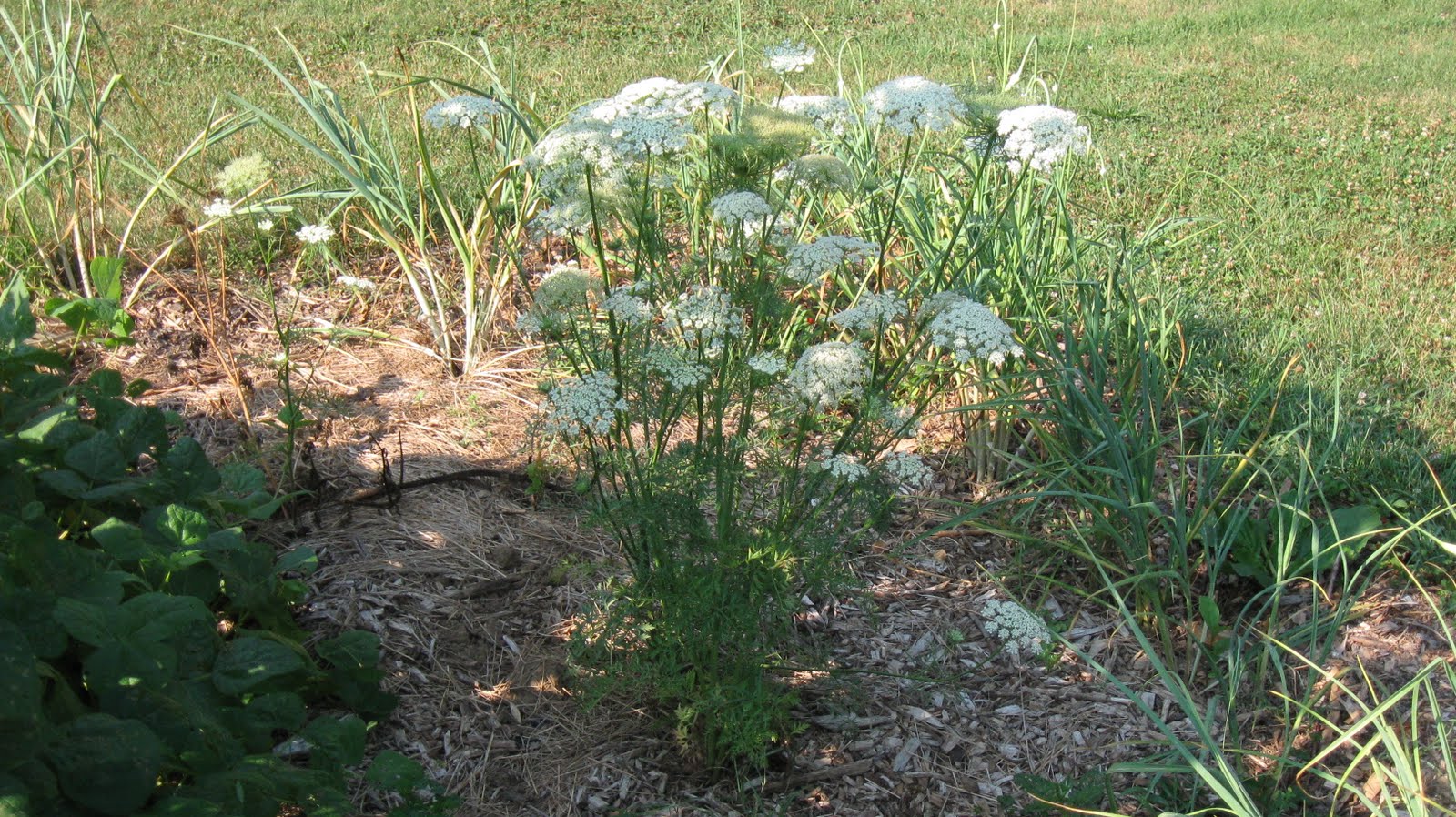
What is this?
Queen Anne's Lace?  No.  It's a carrot, in its second year, producing seeds for next year.

What is this?
Here's another hint.
Yes, it's a blooming artichoke, dagnabit.

Here's something more common.
Whole wheat.

Our biggest volunteer stretches sunward.
"I'd bet you're pretty excited about something that's ready to pick," says Virginia.  "Happy Mother's Day!"

"It's also Son's Day," I say.  Both were born on June 18.

Tuesday, May 4, 2010

Cholesterol Fact and Fiction

I feel conspiracy paranoia settling in -- energy (12 years of Bushes and their connections), war (Bush/Cheney and Halliburton), finance (Bush/Obama and Goldman et al.), oil spills (Obama and BP), and food (everyone).  This food business may be the scariest of them all, because it's so personal.  Maybe I should see my psychiatrist about an anti-conspiracy pill. Oh, I forgot, I don't have one, although I certainly should.

It makes sense that what we put in our mouths could kill us.  Think back to Socrates, who supposedly carried out his own death sentence by drinking hemlock.  He thought he had a philosophical basis for his action and it wasn't "transfat."  Jesus, to the contrary, let his detractors do the deed.  And we're supposed to admire Socrates?

As times goes on, I wonder what we'll discover about our food.  A couple label-readers in my family were comparing bags of snack food the other night.  If I remember correctly, considering the same serving size, each package noted the presence of the same x grams of saturated fat, but one package claimed it was 2% and the other 3%.  Someone suggested maybe it was the result of rounding, or maybe one was 2% of weight and the other 3% of volume (I'm sort of kidding here).  Whatever, I'm sure each was very accurate, aren't you?

One of Karen's friends related a story told by a mutual acquaintance of ours.  He was "having trouble" with "high" "cholesterol levels."  His doctor said, "I'd like you to do something.  Humor me.  Stop eating 'low-fat' foods.  Drink whole milk.  Eat eggs, both their yolks and whites.  Then come back and see me."  When the fellow returned for re-testing, his "cholesterol levels" were normal.

As I rejoiced about my recently lowered "cholesterol levels," one of my brothers suggested stress might be the cause of heart trouble -- that is, higher stress leads to heart trouble and lower stress prevents heart trouble -- and that cholesterol intake might be irrevelant.  I Googled the idea and came across numerous entries addressing the "cholesterol myth," including an article by a purported physician who attempts to debunk the idea of various connections between ingesting cholesterol and heart disease (http://www.becomehealthynow.com/ebookprint.php?id=1112).  According to him, the idea is ludicrous; he says "dietary intake of cholesterol has no impact on the level of cholesterol in your blood."  He also criticizes the characterization of LDL and HDL as "bad" and "good" cholesterol, partly because HDL is a lipoprotein, not a cholesterol.  Maybe one of you is better able than I (I'm useless) to determine whether his arguments make any sense.

"Perhaps food-fussing is stressful in itself," says Virginia, "contributing to the stress that might aggravate heart disease?"

"I don't know," I say.  "Balance in all things (or many things) might be the answer.  I hope we don't discover that fish oil, flaxseed oil, and multivitamins cause cancer or heart disease.  I 'm about ready to drop everything in favor of goat milk.  So much for balance."  (See "Goat Milk Magic" (April 30, 2010) at http://holesinmyjeans-kpannabecker.blogspot.com/.)

Wednesday, January 20, 2010

Nursery Time

After a month of unusually cold, white weather, a warm spell speaks Spring.  Of course, it's a tease.  Fortunately, the nights remain cold enough not to coax the flora into premature rebirth.  As my posting yesterday ("Where the Rubber Hits the Road") suggested, animals may be stupid but plants are not.

Have you ever met an unkind plant?  Virginia steps up to the microphone, "Poison ivy?"  My view on that is a repeat of something I posted a few days ago ("Taking Responsibility") -- if you're too lazy or stupid to recognize and avoid, or wash off, poisons, don't blame the plant.

"What about weeds?" Virginia asks.  Yes, sometimes uninvited plants greatly aggravate me, but even they aren't mean or unkind.  They're simply complicatedly inconvenient, which by definition is what a weed is.

"Bananas," my sister might suggest.  I love bananas, but she wants to form an online Society of Banana Haters, people who think even the smell of a banana is hazardous to their health.  My friend, Mike, used to have a similar problem with celery, although he seems to have aged into tolerance.  One of the SBH mottos would be "Bananas are mean."  I won't touch this one.  How can you argue with such an extremely skewed perspective?

The point is, Spring-like weather portends a kinder world.  My first 2010 seed packets arrived yesterday and I'm itching to get this year's garden growing.  The warm sunshine has melted most of our white blanket and uncovered my November planting of garlic.  It's time to start the earlies on windowsills -- things like broccoli, cauliflower and onions -- so in March they can keep the garlic company.  A couple months after that, my gardens will be overflowing with friendly plants, co-existing in a way animals (humans, anyway) apparently cannot.

"I thought you said plants don't need human help," says Virginia.

"I may have gotten carried away," I say.  "Some of them do better with a little help from friends."

"Otherwise, they get crowded out, just like animals," says Virginia.

"Good point," I surrender.  "They both have their good points.  Why must it always be 'us vs. them'?"

Tuesday, January 19, 2010

When the Rubber Hits the Road

Karen's before and after pictures of Puck, our former rooster, God bless his soul (see "A picture paints a thousand words" at http://holesinmyjeans-kpannabecker.blogspot.com/), provoked a wide range of responses from "rooster killer" to "I'm proud of you; you're a real farmer now."

I'm reminded of the scene in "Julie and Julia" where Julie's husband wanders around the apartment singing "lobstuh killuh."  What strikes me most was his silence when Julie cooked boeuf bourguignon or duck.  Frankly, it's kind of like the millions of world citizens who ignored (and some still ignore) gas ovens in Germany, except, so far as we know, human roasts weren't shipped to supermarkets.  Okay, that's a rather extreme comparison.  Instead, think of Sweeney Todd, the demon barber of Fleet Street, who provided Mrs. Lovett with cheap meat for her pies.  Did you laugh when they sang "try the priest" or "the financier, peak of his career?"

Vegans and vegetarians, you're not off the hook, by far.  Take a fresh green bean, cut it in pieces, and look at it under a microscope.  What are those little things moving around?  They're not vegetables.  Do you think the farmer that grows the vegetables you eat avoids killing creatures as he drags his plow, cultivator or hoe through the soil, which, by the way, has likely been amended by pesticides and fertilizers that animals eat, get sick from, and die?  Moreover, unless you're buying locally grown produce, lots of petroleum has been consumed getting those plants to your kitchen, and as we all know -- but ignore as part of our typical mass denial -- kills not only animals but some on the top of the heap, humans, now and future.

I'm also curious about the distinction we draw between heads of lettuce and beef or pork.  Consider the gentle plant, which produces its own food from (non-living) nutrients it obtains from soil and air.  Unlike a pig or a cow, it doesn't need our daily help.  Instead of rewarding it with respect, we eat it without a first thought regarding its death and sacrifice

"Wait a minute," says Virginia.  "Do you think we resent the independence of vegetables, which is why we eat them without remorse; that our egos object to being at the killing of pigs, cattle, chickens, turkeys and so forth because we made them?"

"Hmmm," I say.  "The next time I lop off a head of lettuce I'm going to be more circumspect.  And hey, you meat, fish and fowl eaters, be there or be square!"

Sunday, January 17, 2010

Epigenetics

Tell-tale signs galore --
ceiling fan turned off,
a toilet paper roll,
open doors, empty bottles.
"Leave no trace" has lost.

Around chromosomes
lies cell material that can
turn off or on the genes
of the next generation.
What we do matters.

"Our true character appears when we think no one is watching," says Virginia.

"Do you mean, when I pick my nose?" says Who.

"No, not you, certainly," says Virginia.

[Note.  Research by a Norwegian physician suggested that boys who went from normal eating to gluttony in a single season, following a season of famine, produced sons and grandsons who lived much shorter lives than boys who ate normally.  Epigenetics is the study of changes in gene activity that do not involve alterations to the genetic code but still get passed to at least one successive generation. Time, Jan. 18, 2010.]

Tuesday, December 22, 2009

Homemade

I'm admiring our driveway, hard blacktop against a soft snow-white backdrop. I'd guess about 30 person-hours of hard work went into this masterpiece. Two cars remain under cover, but if we wanted we could drive them away, to Mexico for example, and well before we arrived at our destination the rest would melt. Adam, Manley, Karen and I deserve to be proud of our efforts.

I think, like all things homemade, it's prettier than the neighbor's lane cleared by gasoline or diesel. I realize I'm biased and you, dear reader, may think I'm full of manure. I'm reminded of a sermon I heard long ago. Two couples had invited the pastor to dinner. At the home of the first couple, everybody climbed into a car and drove to a fine restaurant. The second couple welcomed the guests into their home and gradually served a meal they had prepared. I'll let you guess which meal the preacher considered extra-special. Of course, he waited until his next assignment, or maybe later, to tell the story.

A pickup parked not far away bears a slogan I'd like to steal: "It's not what you buy, it's what you build." Karen often says she likes the home we're living in now much better than the big, more modern house we enjoyed in North Carolina because it reflects us, our tastes, our work, and our eccentricities, unlike the other house, which was always "the Thomasons'" not just to us but to everyone who met us and tried to picture where we lived. Anyone who knew the inside of our current home before we did would not say it looks the same.

Even the garden beds tickle me now, hidden underneath two feet of melting snow. I can't see them, but I know they're thriving, worms working, playing with manure and mulch, getting ready for spring. Try to order a garden online. You might be able to find a gardener to work for you, but I promise you, the result won't feel like "your" garden. It'll feel like that new dress or suit you bought at Bloomie's.

Virginia says she remembers stories her father told about eating foods her grandmother had "put by." Together they would leaf through black-and-white photographs of Grandma's canning kitchen with row after row of glassed-in veggies and meats. When they went grocery shopping in New York, Virginia would search for see-through containers and beg for pickles, applesauce, dried beef, even pig's feet. Now, when children come to visit, she leads them by hand to her well-stocked pantry and lets them choose something.

A visiting friend recently oohed and aahed about our basement kitchen and its antique glass-windowed cabinets. "So," she said, "when you're hungry you come down here and pick out something to eat. What fun!"

You can't buy that.

Wednesday, December 16, 2009

Cuts of Beef

Where is today’s Beethoven? Does he struggle in a condo somewhere, writing furiously, ripping masterpieces to shreds, ignoring Beltone advertisements? Has he discovered conveniences such as triple-headed razors, his pate shaved to simplify life? Are his lips locked in a perpetual frown or does he smile to use fewer muscles?

Plop the real Beethoven into our world. Could he taste trans fats, reverse sugars and the dyes added to products he and our grandparents wouldn’t recognize? Would he notice that the meats we eat could barely walk and never saw real sunshine, that most of us haven’t dissected frogs in science class, much less wrung a chicken’s neck? Like us, would he wash his hands after meeting new people while letting entrees prepared by strangers pass freely through his lips?

We’re so specialized we might die if others stopped working. We dwell on the pronouncements of pretty people who entertain us, politicians who pretend to know what’s best for us (even though we say they don’t), and spoiled brats born with more money in their pockets than we can picture. We have allowed “them” to persuade us to spend our hard-earned cash on things Beethoven didn’t know or need.

“He’d probably enjoy every moment listening to sounds he never knew,” says Virginia, “like crunches of potato chips, the snap, crackle, pop of Rice Krispies, and Muzak on elevators. I bet he’d laugh at the ‘experts’ who try to re-create his music the way it was played when he was alive, as if he could have heard those concerts. I think he’d be more interested in the musician who makes each classic his own.”

Saturday, December 12, 2009

Up on the Housetop

When I mention where I live, Arnold's Valley, some people, even first-time acquaintances, roll their eyes.  A doctor said, "You know, don't you, that rescue squads won't go there?" "You must be the richest resident," someone suggested (if you've met Karen then you probably know I am).  "Found any moonshine lately?" several have asked.  "Seen any snakes?"  People from the valley ask me that, too, when the topic of our cabin comes up.


Welcome to Arnold's Valley.  (Note:  If you click on the photo it will enlarge.)  Within the first clump of trees sits our farmhouse.  The goat barn appears just above our investment bank; the bigger this pile of horse manure gets, the richer I feel.  Thunder Ridge is the blue-gray mountain, under which Arrowhead Lodge nestles.

The people in this valley who share surnames may be proud to announce "we're not kin," but deep down they love each other.  They'd probably like you, as well as the fire-yellers I've mentioned and even folks from the Big Apple (especially Virginia).  If your car breaks down around here, you won't go long unassisted.  If you take a walk, someone will offer you a ride.  Pass anywhere and you'll get a wave.  Even the ambulance drivers wave back.

We say, all of us residents, go ahead and talk trash.  Enough people already call this home.

The top roofer in the county lives a half-mile down the main road.  He's as busy as you may be if you're good at what you do.  On Sundays he likes to show his shiny red Pontiac Solstice the Blue Ridge Parkway, up on Thunder Ridge.  Yesterday he enjoyed the sunshine with a glass of goat's milk and a little soldering.

Friday, December 4, 2009

Moss: "Nothing Tastes as Good as Skinny Feels"

The syntax of Kate Moss's currently controversial quote intrigues me. The fashion model reportedly said, "Nothing tastes as good as skinny feels." She deserves a poetry prize.

Disregarding syntax for the moment, I think the eating disorder critics might not be out of line: "Healthy tastes better than skinny hurts." On the other hand, I don't know her, but I suspect Ms. Moss meant to say "thin" instead of "skinny." "Skinny" means "unattractively thin." "Thin" offers alternatives.

That takes care of that. Now for the intrigue, her comparison of taste with feel. I know less about Ms. Moss than I do about Fyodor Dostoevsky, whose novel Crime and Punishment my online book club is reading. Giving Ms. Moss the benefit of the doubt, let's treat her as kindly as we would Mr. Dostoevsky.

1. When she said "feels," she probably wasn't, but might have been, attempting to compare two of the five senses (taste, touch, sight, smell, and hearing). Picture her hugging herself, thinking "thinness feels good. I'd rather feel this than taste my favorite food."

2. More likely, she was associating taste with emotional feeling. Now picture her sitting in her favorite armchair, eyes closed, arms resting lightly on soft upholstery, thinking how wonderful it is to be thin.

3. I doubt it, but she, like Tommy, the pinball wizard, might have been suggesting that someone else compare two of the senses, as in "Lover of mine, wouldn't you rather feel me thin than taste your favorite food?"

4. We could also consider her choice of the word "taste" over "eat," which casts a very different light on her possible intent. Think of a taster -- of wine or food -- who sees the object, smells it, touches it, tastes it, and maybe even hears it (compare, for example, marshmallows and peanuts), and doesn't swallow. Eat your hearts out, eating disorder critics.

Virginia whispers, "Nothing tastes as good as thinness feels with a little fat and muscle."

Saturday, November 21, 2009

Orange Elegy

Gunshots echo through our valley this light-filled Saturday. It's orange vest weather, but I'll let mine dangle until the new year, except on Sundays. Meanwhile, let me grouse about the expanding roadside collection of cans and bottles as these irritating holiday decorations sparkle in the sun.

This is not a diatribe against smart, responsible hunters. Each year we're blessed with gifts of venison for our freezer. I can admire graceful white-tail deer until they decimate my beets and carrots. I've even been known to contemplate shopping at Nuckols Gun Works. Without hunters, we might have no chance of keeping the deer population under control.

Unfortunately, two heedless hunters have spoiled this season in our neck of the woods, stilling the hearts of two young people. May other guns not point at human targets. And why, tell me, do the cans and bottles pile up this time of year?

Virginia wore orange through November and December as she renovated her sylvan church. She welcomed pressure-treated venison and recycled the cans and bottles tossed from pickups.

Tuesday, November 17, 2009

Homeland Security

When local teenagers found a radio-telephone left by a public safety employee in the bathroom of a gasoline station, they tried it out, resulting in vehicles rushing to a phantom emergency. Rather than charging them with felonies, I wanted to reward them for pointing out a serious glitch in "homeland security." Recent reports have disclosed that our country's air traffic control system is outmoded and does not provide real-time data; if I remember correctly, it tracks planes twelve seconds after they've been.

Eight years after 9/11/01, homeland security remains elusive. I feel as if we've checked our brains into high school lockers. When I see the fancy new emergency vehicles purchased with federal funds, I think of the Mustangs teenage boys covet and crash. If the things last, they'll be outmoded in three years.

A particularly important failure sticks out. How can we expect to be "safe" if we depend on distant supplies for the basics of everyday life? It's been reported that the average food item on an American table has traveled 1500 miles. If you think that's normal, let me mention that the same average for Italian tables is less than 50 miles. Our number one priority should have been, and should be, developing local and regional resources, not fighting civil wars overseas (Virginia whispers, "could any war be 'civil?'"). We need plans that focus on satisfying basic needs with products available nearby, including food, water and energy. In the event of an emergency, the "battle" will be lost if many of us are thirsty, hungry and power-less.

Monday, November 16, 2009

Debitarian

A vegetarian, in an op-ed piece in today's Washington Post, wrote that he's tired of apologizing for causing inconvenience at dinner events. He argued that it's time for carnivores to apologize for their adverse environmental effects.

I'm a debitarian and I think it's time for the high users of consumer credit to apologize to the rest of us for their adverse economic impact. If they hadn't been greedy, and susceptible to encouragement from mortgage brokers and other moneymongers, the recent financial collapse might not have happened. I'm not against credit altogether. I support responsible use -- say, a mortgage loan well within the borrower's ability to pay, a credit card balance he or she could pay off within a month (or maybe three), and occasional use for true personal financial emergencies, such as medical treatment.

Did you know that beginning about 2004 banks began allowing customers to exceed their account balances when they used debit cards? Now over 80% of banks allow this. Abracadabra, the debit card suddenly becomes a "credit" card, often without its user even knowing it.

I think practices like this contributed to the financial crisis we're in and may hurt our ability to crawl out of it. I expressed this opinion, including my recommendation that the Federal Reserve Board ban the practice, when I commented on the Board's proposal to sanction the practice so long as the banks disclose what they're doing.

The Fed ignored me. The banks "need" those overdraft fees. The final regulation, adopted last week, simply requires disclosure in advance, which could be as early as when an account is opened.

The mom of Phil, a banker who had the hots for Virginia, was impressed by Virginia's reaction when she learned that she had "earned" the trust of her grandfather. Even before Virginia knew how much money was involved, she made sure her sister would share the bounty. Virginia was a debitarian, too.

Friday, November 13, 2009

Picking Peas in November

I picked peas this morning, enough for one good serving or to flavor the soup Karen's planning to make for dinner. I think Barbara Kingsolver (Animal, Vegetable, Miracle) is firming Karen's localvore resolve. We produce a large portion of what we eat, but haven't eliminated our grocery bill. I like to think that's coming.

The more I read and hear about the food sold in stores, the more I wonder if that's the biggest reason why each of us is at high risk for cancers. Most of us think either too little about what we put in our mouths or too much about it for the wrong reason -- "I'm too fat."

I'm looking forward to tasting goat meat. At the same time, I'm a bit queasy about eating Chaps or Telly. Maybe the best way to go about this is to find another goatherd and trade butchered animals (without mentioning any names). When my college roommate called this morning, he mentioned that a goat resides in their freezer. He said nothing about its name or breed. He said the one dish they've made so far, a curry dish, was very good, not at all "gamey" and more like beef or chicken than lamb.

Speaking of chicken, I'm working up to wringing my first neck, maybe next Spring. So far, each of our 10 hens has been focused on laying eggs so as not to draw attention to itself. The rooster, Puck, has come the closest to roasting, having not prompted anyone to go broody, but we've promised him leniency through at least one Springtime.

Virginia is a localvore, without being radical about it. Mung, down the road from her place, is the rich radical.