Saturday, September 17, 2011

Beanucopia

We are now harvesting my last plantings of green beans for 2011. Today we cleaned a bucketful I picked this morning, plus some guys we'd stored in the refrigerator.
Here are the jars ready to go, filled with boiling water.
"So green!" says Virginia.

Yes, it's too bad canned beans turn such an ugly -- I'm not very good at this color thing, but after looking through a color chart I'd pick -- ooze.  Oh well, they're good in soup, and soup colors are almost always far from fresh.

Ending up with 14 quarts, I decided to put two pressure canners to work, including one we found a couple years ago in a Goodwill store. Perhaps that was a risky proposition since I haven't tested its pressure gauge. I basically ran them side-by-side, overdoing the pressure and the time on the unknown canner. So far so good.

Thursday, September 15, 2011

Gobbledygook and Psychobabble

Finally, in September, it's time to freeze sweet corn. Three or four ears have been favoring my lunch plate for more than a month, and now the last two plantings are ripening too rapidly for us to eat. Same with green beans. In fact, at the moment I'm behind on everything. My editors probably think I should be working on a deadline that's passed instead of writing a blog entry.

"Are you going to mention why?" says Virginia.

Why what? Maybe. Sometimes a little diversion goes a long way. I could admit that teaching a law school class has bled time from my usual pursuits, offering a captive audience for someone hungry to share tidbits after more than 17 years of fairly solitary studying. Two classes, two drops. When I left the building, it was raining. I don't know if that's a bad sign or nothing at all.

I let the writing get away from me, consume me, as if 17 years of passing persistence called for redemption. Maybe I had to be doubly sure it was real work. Are these the doubts of a possible imposter? Peel the onion. Does it stink?

Saturday, September 10, 2011

Please Don't Cut Off My Nose

Our friend, Marilyn, dropped by with some bulbs this spring, gifts from gardener to gardener. I buried them here and there, marked by labels the chickens soon removed.
"Did the flower appear all of a sudden?" asks Virginia.

Like a surprise lilly, does she mean? Maybe. It "appeared" to our noses yesterday, which led us to the flower.

Wednesday, September 7, 2011

Some of a Man's Best Friends

Each morning I look for treats. A rich, soaking rain helped bring up some lettuce the night before last.
These little beets are several days old.
Consider the innocence of raindrops on eggplants.
New Zealand spinach volunteers every spring, then produces for three seasons. I think it may be calling us home.
Merry Christmas in September. Plant the red balls for spring asparagus, three years hence.
Here's a sweetheart.
We usually have to wait all summer for these to thicken.
"Don't forget your best friend," says Virginia.

Monday, September 5, 2011

Words, Words, Words

As rain pours, making ponds of our goat paddocks, I ponder the practicality of being proud. We met a woman the other night who insisted her husband is the only man she ever met who has no ego. That's what she said. Maybe she meant he isn't egocentric. Perhaps that's why I liked him. I don't think so.

When we lived in North Carolina, many people said, "I'm proud of you." In a way, it was like being in a non-English-speaking country. Someone who barely knew us would say, "I'm proud of you." The statement was believable, said with confidence and certainty. It was not fluff. Well, maybe it was, but it sounded sincere, not like the "love ya" that gets tossed about so easily. For me to believe that phrase, it must be said fully and completely, "I love you," with no ambiguity as to who loves whom.

Many religions view humility as a virtue and pride as a deadly sin. I understand that St. Augustine wrote that pride "is the love of one's own excellence" and in the words of Meher Baba, "Pride is the specific feeling through which egoism manifests." Some philosophers consider pride a virtue. Funny thing, in one week one can receive a compliment for humility and a suspicion of pride. Hmmm, maybe it's okay coming from someone else but not from oneself or, like ice cream, chocolate and almost everything else, in moderation.

"I thought pride was a pack of lions," says Virginia.

Of course she's right. Rrrrr.

Saturday, August 27, 2011

Planting Fenceposts By the Light of the (Full) Moon

I used to roll my eyes when someone suggested herbal remedies. Then I met a physician who made fun of "old wives' tales." Maybe I began to change my mind because she also seemed amazed that anyone would choose to live in Arnold's Valley, where we live. Yes, a childish response, but hey, under stress we typically turn childish, don't we? Maybe I misinterpreted her comments. Since then, she's earned a reputation for being open to alternative treatments, such as bee sting therapy.

And then came Darla. This little goat contracted an infection in her neck within 2 weeks after birth. The spot grew and grew. Darla became our in-house guest for a little while. A vet aspirated the abscess, we aspirated it, a vet removed a lymph node, and Virginia Tech vet experts also tried to remove the growth. Each time we followed treatment with a penicillin regimen. When the thing began to grow again, Karen cried, convinced she'd have to say goodbye to Darla.

Wait a minute. Let's call our friend, L, who's into herbal treatments. Maybe they work for humans, maybe they work for goats. She suggested grapefruit seed extract and oregano oil. Karen gave Darla the grapefruit seed extract (GSE) orally a few times, and rubbed the oregano oil, and sometimes the GSE, on her neck twice a day. The swelling gradually disappeared. A couple months later, Darla seems to be a normal, healthy goat -- well, above normal actually, she's a lover girl.

"Until you wrote this blog entry," says Virginia.

Hush. That's nonsense, an old wives' tale. It'd better be.

A few days ago, the lower right palm of my left hand began to hurt like crazy. I don't remember any trauma. Maybe I pricked myself when I pulled a couple thistles and some mature pokeweed. The pad of my hand swelled and during the first night throbbed badly enough to disturb my sleep, not a simple thing, I've been sleeping like a baby after all the exercise I've been getting this summer.

All right, no big deal, except my left leg way up high began bugging me a few days before the hand thing. Could they be connected, like, um, I won't mention the word that comes to mind in my family and many others these days?

Hmmm, what should I try? Tea tree oil is supposed to be good for treating insect bites. Karen rubbed some on last night, and some calendula oil this morning. Tonight the hand feels almost normal.

"Like wow," says Virginia, "as if the same thing might not have happened without the oils."

Yeah, she's right. But I think I'll rub some oil on that leg tonight.

Tuesday, August 23, 2011

Earthshake, Oooooo

As I munched on 5 ears of sweet corn (some reflected the lack of rain and weren't filled out), the house shook for 15-20 seconds. I thought Karen and Fred, our friend the electrician, were shaking wires in the ceiling of the basement kitchen. I almost said, "It sounds like Clifford, the big red dog, down there." The house shook again a minute or two later.

I didn't think anything of it until Fred's wife called to say there was an earthquake in DC or somewhere east of here. She'd seen something on television, I guess. Inquiries began coming in from around the world, Kansas first.

"I didn't know you had any friends," says Virginia, "until a government action brings them out."

What do you mean?

"Well, you said you didn't give it any thought," says Virginia, "until someone, probably a government agency, reported an earthquake. Then you assumed it was an earthquake."

Heck, she's right, sort of. Maybe it wasn't an earthquake, just a sympathetic vibration imagined by a few hundred thousand or million people. After all, one of our nieces in Ohio didn't feel it, while people around her did. The air may just have been full of brain farts, nothing new.

Sunday, August 21, 2011

Tomato Man

We've been known to invite complete strangers into our home, actually, not complete strangers, I mean, how complete a stranger could an Appalachian through-hiker be? To some people they might seem strange or irresponsible, but to us, they seem, maybe, adventurous, energetic, thoughtful, perhaps even wild or romantic.

What's the worst that could happen? They're not going to steal much. After all, they've chosen to hike 2100 miles with a backpack and by the time they get to Virginia they've learned to keep that pack as light as possible.

"Stink up your washing machine for a month?" Virginia offers. Yes, Karen would probably agree with that.

What's the best that could happen? They might become friends. Several have returned after summiting Mt. Kathadin. One fellow came back yet another time to house-sit while we spent a month in Italy, and again after that. Our current guest is a through-hiker friend of a through-hiker friend of our house-sitter, who stayed here 2 years ago during his own walk in the woods. He's helping Karen move pigs as I write this. I'll be the cameraman shortly.

Before the pigs, he gave me a lesson in tomatoes. He knows tomatoes because he and his dad grow tomatoes for production in Mississippi. Never put tomatoes in a refrigerator, he says. That will kill their nutritional value.  Don't put them on a sunny windowsill either. They'll last longer in an open paper bag. Spreading them apart is a good idea because the more they're exposed to the ethylene gas they put off, the sooner they ripen. If you want a red one, put it in a paper bag with a banana. The gas from the banana will ripen it fast. (My sister will love this news, as much as she loves bananas.)

Don't they taste best when they've ripened red on the vine? Probably not, he says. Pick them when they first begin to "break red," that is, begin to turn red. Supposedly, the vine shuts down on a tomato at that stage, so there's no point leaving it on any longer. Besides, leaving it on longer might take energy from the other unripened tomatoes.

"Hmm, if the vine shuts down on it, why would that take energy from the other fruit?" asks Virginia.

Search me. Anyway, I was more interested in how to prune my tomatoes for best production. Start early, after the plant's grown a foot or so and has put out a sucker. Limit growth to two vines per plant by breaking off all but the main stem and the first sucker. As those two vines grow, continually pick off suckers. Each vine will grow three leaves, fruit, three leaves, fruit, etc. Tie the vines up a wire or stake and train them along for as long as they'll go, sometimes 60 feet.  Chickens may get the first fruit to ripen, down low, but they won't be able to reach the higher tomatoes. The fruits will ripen in order from the bottom of the vine up.  As you pick them, remove the leaves below, so you basically have a bare vine up to the bottom fruits still ripening. You want the vine's energy going into the necessary leaves and fruit, not to needless leaves. The number of leaves required per vine depends on the variety of tomato; generally, 20-30 leaves is sufficient.  (A "leaf" consists of a frond with all of what I previously might have called "leaves.")  By the way, these instructions assume your variety is "indeterminate," which means the fruit ripens gradually from bottom up. The seed packet should say whether the seed is indeterminate or determinate.  Determinate varieties, for which all the fruit ripens at the same time, are used by many commercial growers that use automated pickers.

Our friend worked on a farm in Colorado last summer.  Before he came, the farmers found themselves stuck with picking green tomatoes because they couldn't get their plants to produce fast enough in their climate. With his help, they had red tomatoes for 2 months.

My work's cut out for me this Fall. Gotta get some more tomato plants in the greenhouse and see what we can do by Christmas. Maybe try the same with cucumbers. Next year, do this outdoors with tomatoes, cucumbers, vining squashes, and more.

Monday, August 15, 2011

Still Life II

"How sad!" says Virginia.

Last Spring I had an itch to plant something while I waited for my fairly full garden to sprout.  So I grabbed sunflower seeds and buried them here, there, and all around.  A couple months later their yellow heads livened everywhere.  This fellow took a donkey blow, faring a little better than his devoured neighbors.  I planted a few more last week, hoping they might mature before our first frost.

Not so sad, Karen and my niece, Kendra, helped me prettify these breath mints for use this winter.  
Lest you think we'll run out, here are two buckets and a basket with more of the same, without the stalks. Want some?

At the other end of the gardening spectrum, here's whazup right now.
October Beans A-Comin' with Turnips on the Side
Lettuce Under an Ash Tree
Eggplants Trying
Sweet Potatoes Seeming Happy
The Parsley and the Pea

Saturday, August 13, 2011

Still Life

Finish Line

"What on earth is that?" says Virginia.

It's what I collected at the end of my run this morning, littering the roadside along the edge of our field. I decided it would make a nice still life. Several titles crossed my mind, including "Dr. P Rejected."

"Were you feeling rejected this morning?" says Virginia.

Not at all, nor was I feeling like a "doctor." The Dr. Pepper bottle struck me deepest because there it lay, barely touched. Who threw it and why?  

Maybe a rich man had seen soft drinks on the shelf at Tee Pees and bought a bag of a bunch of brands. After he mounted his Mercedes, he grabbed a bottle and took a sip. "Yuck," he said as he threw it out his window.

Perhaps a poor fellow had reached into his pocket and found barely enough coins to buy one bottle. He savored the first sip and another as he walked down the road, carefully screwing the cap on after each drink. "Oh no." He pretended to trip and set the bottle on the ground. A car stopped to give him a ride. "Close one," he thought, knowing the driver, his "fiancee," would have leveled him with a tongue lashing if she'd seen that he'd wasted money on a Dr. Pepper.  

"You're being too kind," says Virginia.

All right. Some slob threw the thing out his window with no thought, the same kind of attention he gives most of his life as he gripes about government spending, how much trouble he goes through to get his disability claims paid, and how seldom his wife cleans house. 

Did you know still lifes were popular in ancient Greek tombs because some people believed the subjects in a still life would become real with reincarnation?  May "Finish Line" or "Dr. P. Rejected" be the first thing our litterbug sees when he or she begins the his next life.
Keri, our Great Pyrenees Pup

Wednesday, August 10, 2011

Perceptions

I've been reading the fascinating book, Musicophilia, by Oliver Sacks, a neurologist. He writes about musical maladies and phenomena, such as those of folks who get struck by lightning or are injured in an accident and suddenly discover a new interest in playing piano, composing or listening to classical music. He includes a chapter on "idiot savants," who typically are male and have one amazing ability -- such as total recall of music they've only heard once with the talent to play it on the piano and transpose it to any other key. Another chapter addresses people who lose hearing in one ear and then compensate for not being able to hear in stereo by moving their heads slightly while listening and/or compensating by developing additional brain skills.

A chapter on absolute or perfect pitch suggests that most of us might have been born with absolute pitch but failed to recognize and develop it, and therefore lost it, when we learned language skills. This is supported by the high percentage of people who speak a tonal language, such as Chinese, who have perfect pitch, compared to persons who speak non-tonal languages such as English.

The general concept that struck me most is that listening to music requires the coordination of a multitude of skills. Of course, we hear the basic elements of pitch and rhythm, but we also hear tone, timbre, loudness, tempo, contour (rise and fall), spatial location, and reverberation. People with absolute pitch notice another element, which some call "chroma" -- such as the personality of an F# or Ab. Hairs in our ears, the shapes of our inner and outer ears, and other aspects of our ear physiology receive these elements and our brains combine our receptions into a listening experience. Some ears and brains lack certain capabilities, bringing a different experience to their humans, which at times can be irritating or disappointing, especially in the event of a change caused by an injury or illness. Similar differences happen with sight and, I suppose, the other senses.

"So what I see and hear may be different from what you see and hear," says Virginia.

Exactly. I recently discussed this with an artist friend, who recalled that once upon a time when she was lying in bed with one eye closed, she noticed that the wall was -- I forget what she said -- let's say pink. She happened to close that eye and open the other and saw that the same wall was another color, let's say orange.

I had a similar experience about 25 years ago, but mine was auditory. I was on a telephone call. When I was put on hold I noticed that the music being played to entertain me while I waited moved up a half-step. I thought, "now, why would they do that?" A little later, it moved back down a half-step. Then it moved up again. Eventually I realized the pitch changed whenever I got tired of holding the phone with one hand and switched it to my other ear. This hasn't bothered me. My brain normally takes what I'm hearing through two ears and interprets it as one pitch, which happens to be the "correct" one. At least, people who hear me sing say I'm in tune. I suppose they could be humoring me.

I recently heard a singer performing flat, on every song. I had enough bad taste to ask a couple other people if they agreed with me. They did. Having read Musicophilia, next time I'll be more considerate.

Sunday, August 7, 2011

Pressure Canning -- Don't Blow Your Top

Many people have told me they don't pressure can because they've heard stories about canners blowing up and making a mess of kitchens. Maybe this will help allay their fears.

First, if appropriate, heat up what you're canning. In this case, we're canning pizza sauce, so we need to make it hot.
In the meantime, check the petcock/counterweight hole on the canner's lid. Can you see daylight through it?
If you can, great. If not, you need to clear the way. Sterilize your jars. I rinse clean jars with water and microwave them for 3 minutes, or pour boiling water over them. Fill them with pizza sauce or whatever you're canning, leaving the proper headroom, 1/2 inch from the top for this pizza sauce. Place a sterilized canning lid on top of each jar and screw the ring tight. Place the jars inside the canner with enough water to rise two inches up the side of the canner.
"Only four jars?" says Virginia.

I hate to use a 7-quart canner for only 4 jars, but in this case that's all I have to can.

Check the gasket for the canner's lid, making sure it's properly lined up, then turn the lid on tight. This is hard to do with our canner. I do the best I can. The less tight, the more likely it will leak and drip water onto your stovetop, which is no big deal so long as it doesn't drip too much and you have enough water inside.
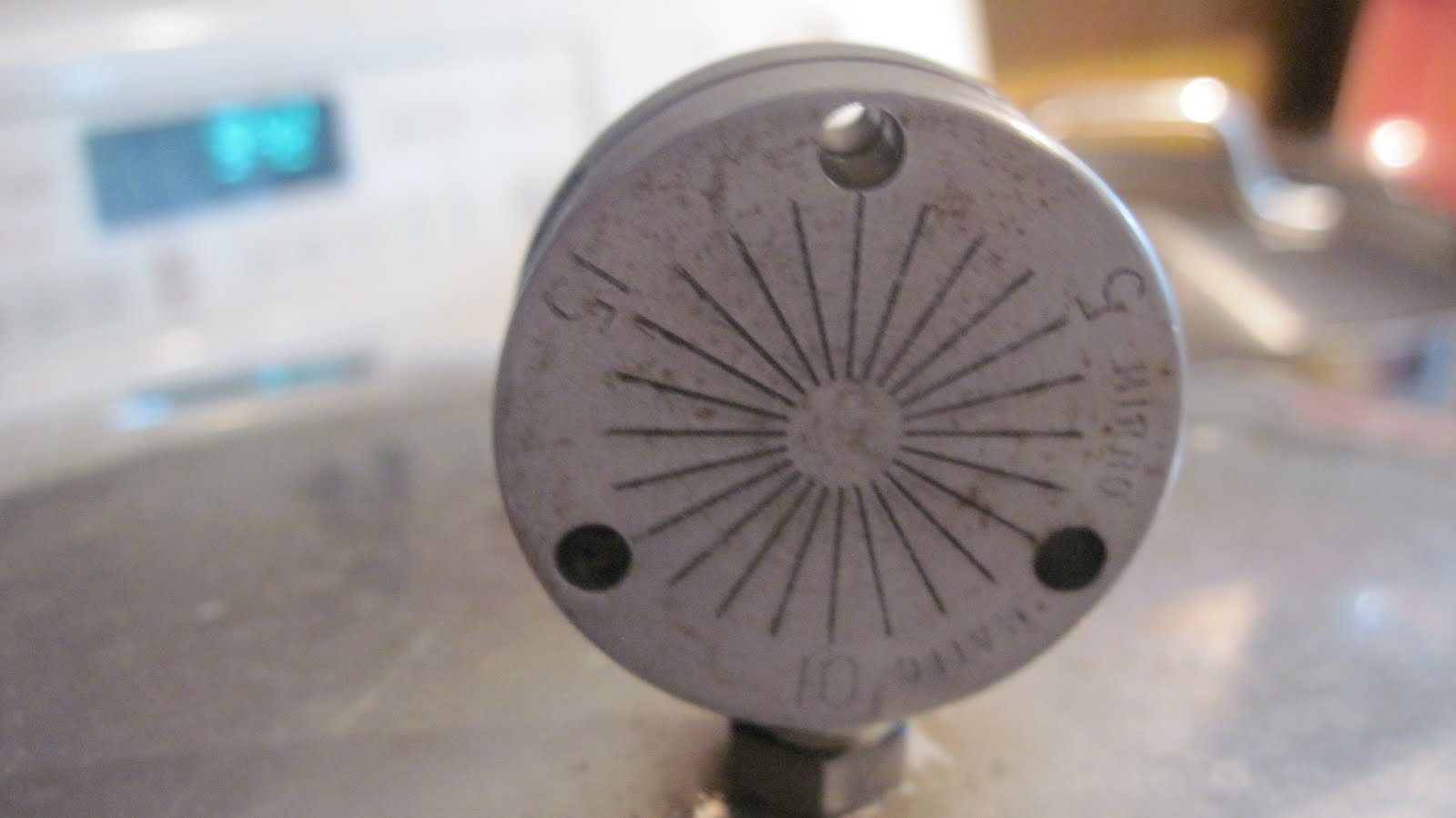
Now for a step some folks forget. Don't put the counterweight on yet. Turn on the stove burner and wait for steam to come out the hole on which you will set the counterweight. After the steam begins escaping, wait at least 10 minutes to be sure the air is expelled from inside the canner. Air trapped in the canner lowers the temperature for a given pressure and may result in under-processing. This step is very reassuring. You see the steam coming out the right place, so it's hard to picture an explosion in the wrong place. After 10 minutes, set the counterweight on. (Some of your pressure cookers have pressure gauges; I haven't used them, so I can't help you there.)
Use the 10 pound hole for this pizza sauce.
Wait for the counterweight to begin to jiggle as it lifts up to let out pressure and down until the pressure builds up again. Listen until the jiggle goes at a good clip (the directions for your canner should provide better advice on what to listen for), then set a timer for the appropriate time, 40 minutes for this pizza sauce.
As time passes, if the jiggle sounds too aggressive, turn the heat down, but not so low the jiggling stops.

When the time's up, turn off the burner, remove the canner from the burner and let it cool. Don't try to take off the pet cock until the pressure has relieved or you may get burned. Ditto, opening the canner. Probably the best thing to do is something else so you forget about it for a while. After it's cool, open her up and remove the jars. Presto!

By the way, you can remove the rings now. If the lids have properly sealed, the rings are no longer necessary and there's no need to keep a huge supply of rings around. And -- if I've messed up -- let me know, please.

Saturday, August 6, 2011

A Tit for a Tat?

You've probably heard or read that S&P downgraded U.S. debt from AAA to AA+.  AAA supposedly means the obligor has "extremely strong" capacity to meet its financial commitments, while AA+ means the obligor has "very strong" capacity to meet its financial commitments, differing from AAA only a tad.  I understand that earlier this year, four companies were rated AAA:  Exxon/Mobil (XOM), Automatic Data Processing (ADP), Johnson & Johnson (JNJ) and Microsoft (MSFT).  For more on S&P ratings, see http://www2.standardandpoors.com/spf/pdf/fixedincome/Ratings_Definitions.pdf.

To add a little perspective, I understand that yesterday S&P rated Ireland's debt as investment grade (AAA, AA, A or BBB), giving it a BBB+, a few notches above junk. Meanwhile, Moody's rates Ireland as junk -- Ba1.  S&P rates Greece as CCC -- very bad junk indeed.

But what exactly is S&P saying about the U.S.? The U.S., unlike Exxon or Microsoft, can print dollars to repay its debt. Does S&P think the U.S. Mint is about to explode?

"It sounds like a case of the pot calling the kettle black," says Virginia.

She's right. If I'm not mistaken, S&P was one of the credit rating agencies that rated subprime mortgage-backed securities as investment grade -- and remember what happened just three years ago! Some people place some of the blame for our current financial crisis on agencies such as S&P. Presumably the credit rating agencies have changed their practices since then.

Or maybe it's all politics. I don't know about you, but I'm finding it pretty hard to distinguish fact from fiction, honesty from dishonesty. If S&P were a child, I might suggest its latest downgrade is a little tantrum, thrown at the government that, in the Dodd-Frank Wall Street Reform and Consumer Protection Act, included a subtitle aimed at credit rating agencies, now called "nationally recognized statistical rating organizations" (NRSROs). That subtitle -- Subtitle C of Title IX (Title IX being the Investor Protection and Securities Reform Act of 2010) -- comes down very hard on the credit rating agencies that granted inaccurate or misleading AAA ratings to securities backed by subprime mortgage loans. Among other things, it empowers the SEC to regulate NRSROs and requires all government agencies to reduce reliance on credit ratings by removing references to credit rating agencies and NRSROs from their regulations.

"Slap me, I'll slap you back," says Virginia.

Thursday, August 4, 2011

Buy or Sell

When I mentioned to a brother that the Dow Jones Industrial Average had fallen 270 points this morning, he said, "Time to buy?" I said, "When it hits 7,000, maybe 8,000."

"What's wrong with you?" says Virginia.  "Don't you believe in our resilience?"

I guess so, long-term.  Unfortunately, there's no good economic news out there and it's not raining. Fortunately, our pump is located near the garden so I can water every day. The next planting of green beans is coming along nicely. Can't say the same for our representatives in the National Capital.

"Now that they've raised the debt ceiling, maybe they can concentrate on jobs," says Virginia.

Right, when we get to the final quarter, or more likely, the last five minutes, maybe, like a sports team, saving energy until the end. The big problem with that approach is -- unlike a game, we don't know when the end will be. Think global warming, for example. It's happening and there are things we can do, whether or not humans are solely responsible for it. I'm afraid, until the end is nigh (or past), we'll keep our heads buried in the sand.

"It's in God's hands," says Virginia.

I see the smile on her face. God passed the ball, "Show me what you can do." I have this sinking feeling we may have dropped it about the time we decided to let someone pursue McDonald's for spilled hot coffee. Come on, team, let's show what we can do! I think I'll go do some watering.  I hope I haven't waited too long.

Monday, August 1, 2011

Home-made Goat Milk Ice Cream

At least once a week we make ice cream -- goat ice cream, of course.  All it takes is 1 quart of milk, 1 cup of sugar, 1 tablespoon of vanilla, and 2 eggs.  if we feel like using alien material, we add 8 ounces of evaporated milk or cream.  Otherwise, we add 8 more ounces of milk.  Plus, ice, ice cream salt, and the electric 2-quart ice cream maker my mother gave me when she down-sized her living quarters.  Of course, the milk mixture goes in the stainless steel cylinder that spins around the beaters.  After that's locked in, we fill the plastic bucket one-third with ice, sprinkle salt on top, and repeat twice.  Then add a couple cups of water.

After 20-30 minutes of noisy mixing, we sit down to deep bowls of udder delight.  We don't re-pack it like some folks do.  We like soft-serve.  If we wanted the hard stuff, we'd run next store to Tee Pee's for Hershey's, and try not to worry about what's in it.

"Why would you worry?" says Virginia.

Unlike ours, Hershey's is made from industrial milk, probably heated to kill all the good stuff and leave white nothingness.  Ours is full of free-ranged omega-3 fatty acids and other wellness-promoters.  Yum!

Monday, July 25, 2011

Global Rupture?

The pigs are doing a good job roto-tilling a garden bed, their test site.  We're getting a little sweet corn from the field garden, which will be their next project.  Some winter squash seems to be doing all right in that garden, too.  If we put the pigs out there, will they stay inside their electric fence?  We plan to gradually move them around the big garden.  A fence break could badly mess things up.  Hitting a deer is no fun.  Hitting a pig wouldn't be, either.

If the field garden experiment works, then we may move the pigs or their replacements around the field.  Bit by bit we might be able to plant the field with native grasses and animal food, such as oats and barley.  Or blueberries, pumpkins, strawberries, etc.  I don't know about monoculture planting though, a quarter acre or twenty-five.  How big does it have to be before it becomes monoculture?

Reading Silent Spring, including Rachel Carson's account of the use of DDT on elm trees in Michigan and elsewhere, leads me to wonder if, 60 years later, the robins have returned.  Have we learned from that experience or are we doing the same sort of thing with "safe" treatments like Roundup?  There's so much we don't know.  We should be wary of introducing any inventions into our planet's ecosystems.  I'm inclined to apply the grandmother test -- if grandmother wouldn't recognize it, don't eat it, and think ten thousand times before spraying it on plants. 

"Hey, what's it matter?" says Virginia.  "The rapture is coming soon."

She's a kidder.  Too bad many other people aren't.

Sunday, July 24, 2011

Mirrors and Tombstones

Imagine looking in the mirror every morning (for a week or two) and seeing this:
You might hear, "Dahling, quit dilly-dallying."

Or this might be cool, sort of Fonzarellian (think Arthur Herbert Fonzarelli, "the Fonz" on Happy Days):
Here are some pretty bugs -- pretty darn nasty.  Our chickens have been getting most of them this year.  If you don't have chickens, I understand spraying them with a mixture of warm water, vinegar and some dishwashing liquid will send them to la-la land.  They suck, trying to destroy all the brassicas before moving on to other crops.  These two Harlequins are enjoying Brussels sprouts.  Aren't they beautiful? 
Here are some German Cushaw squash I trained to hang on the fence.
"Are you sure?" says Virginia.

Well, the seeds came from a Southern Exposure Seed Exchange packet labeled "green-striped cushaw."  A Google search of cushaw brings up several pictures of what I thought were Georgia candy roasters, which happen to be growing to the left of these guys.  Here's one:
Whatever, these are giant winter squash.  Cut one open and it feeds two people for two weeks.

If you read my blog entry from yesterday, about cleaning up the greenhouse, here you can see what I've been doing -- pulling weeds, then covering with a layer of black plastic under a layer of black mesh cloth, and in the aisles, a rubber mat.  The wooden 2 x 6's will form the back sides of two more beds -- I'll be cutting and removing the plastic to the rubber runner -- in which I'll plant, who knows, maybe lettuce, broccoli, artichokes?  In each corner, I covered the black mesh with mulch and then four 2 x 6s that hold a broken marble tombstone that's intended to keep the greenhouse from blowing away in a storm.  No grave robbing;  a friend of ours who digs graves brought us four rejected broken tombstones.

Saturday, July 23, 2011

Greenhouse Reconstruction

A rush job almost always has to be redone, doesn't it? 

On our 22nd anniversary last October, having received an email that a local business was shifting gears and selling their greenhouse, we checked it out and bit.  Two weeks later its pieces were in a pile near our older and littler greenhouse.  Then in a few more weeks it was up and ready to go, except I hadn't given much thought or attention to the floor.  That was fine until this summer, when the place entered the first stages of becoming a forest. 

This week, after meeting pressing deadlines, I attacked the weed patch, put down black plastic covered by black mesh cloth and, in the two aisles, laid long rubber mats, all despite 110+ degrees even with big fans blowing.  I was not about to plant fall garden things and winter greens while having to push aside wiregrass growing like cobwebs.  I also began to close gaps in an attempt to get the place ready for cold weather.  I'm not finished yet, but it's looking civilized again.

"Fans blowing?" says Virginia.  "In your greenhouse?"

Umm, haven't I mentioned that for our birthdays this year, we had electricity installed in the barn and the greenhouse?  Now my plants can listen to classical music.

Friday, July 22, 2011

Gotta Live in the Present

My cellphone's on the blink.  It didn't work for a couple days.  I could send out, but couldn't hear anything coming in. 

"Not so unusual," says Virginia, "for you."

She's right, as usual.

Wednesday, July 20, 2011

Happy Birthday, Dodd-Frank!

Most of us have awakened in the middle of the night and fretted.  Something about the peace and quiet of a dark space often invites focus on something, anything, that suddenly takes on incredible importance.  Next time this happens I think I'll turn on a light, in the hope that seeing other things will turn my thoughts to more realistic matters.

I used to wish that aging would turn me into the kind of wise man people liked to visit.  Phooey.  What a self-centered thought, like the patient who wants everyone to know what he's going through!  I have a feeling wise men have other things to do than hope people want to visit them to learn their secrets.

"Where are you heading with this?" says Virginia.

All right.  You probably don't care one bit that tomorrow, July 21, 2011, is the first anniversary of the enactment of the Dodd-Frank Wall Street Reform and Consumer Protection Act, a/k/a the financial reform bill or the banking bill.  I, on the other hand, who has been immersed in it day in, day out for the entire year, see the day almost as light at the end of a tunnel, albeit a temporary end.

But yes, I get it.  It means nothing to most people.  It's time to pull weeds in the greenhouse.

Sunday, July 17, 2011

Arrowhead

Today, I dug holes for a couple peach trees.

"You should plant trees in the spring or fall," says Virginia.

Yes, maybe.  Anyway, I lifted a shovel of dirt and dropped it onto the pile I would later return to the hole, and a tiny stone caught my eye.
Front
 Back

"How do you know which was front and back?" asks Virginia.

Picky, picky.  What do you think happened a few thousand years ago when this arrowhead dropped to the ground?  Squirrel, rabbit, bird?  Maybe not.  I understand even projectile points of less than an inch could drop a deer (http://archaeology.about.com/cs/lithics/a/thepoint.htm).

The stone may be worth 87 cents.  The experience is not.

Saturday, July 9, 2011

Feeling A Draft (Draught, Dray)

When we lived in our cottage and cabin 4 miles up the road, the relatively unusual sound of a car would announce that someone was coming several minutes before they arrived.  We had time to prepare.  Now, comparatively, we live in a city.  Everyone coming into or going out of the valley drives past our house, and you can't get to Yogi Bear's Jellystone Park without sending at least a little road noise our way.

Maybe we keep getting more animals because we hope they'll drown out the engines.  They're pretty effective at slowing down traffic, as people gawk, "Hey, look at the cute goats.  What is that, a mule?"  Many people think a donkey's a mule.  More and more often, it seems, strangers drive down our lane, as if it's a petting zoo.

When I read this ad in the local paper, I had to call: ""Farming with Horses -- I am seeking a working farm and farm family in Rockbridge County who could be interested in, would enjoy, and whose farm would have work for and might benefit from a pair of light draft horses and horse drawn equipment, wagons, harnesses, tack etc. ready to go to work farming, logging, giving wagon rides and being ridden.  Along with the horses and the needed equipment would come their owner several days a week, ready and wanting to go to work and pitch in to the best of his ability.  I'm on the lookout for a working farm family that will be real particular about any addition of livestock or people to their farm, just as I'll be in finding the right farm and family.  I will greatly appreciate hearing from anyone having possible interest, thoughts or leads regarding this quest."

I can picture traffic slowing way down if a man and a horse were working our field.  It might be necessary to open the gate so folks could park and watch, rather than frighten the horse with screeches, screams, sirens and ambulances.  Maybe in 5 or 10 years, I'll be ready to try a draft horse.

"It'd be so cool," says Virginia.

Hmmm, maybe not on a summer's day like today.

Tuesday, July 5, 2011

Garden Grocery

Olga doesn't feel lonely for long this time of year because she has frequent visitors.
Eleven young chickens peck around all day, attacking insect pests and occasionally, young seedlings, which I try to overlook because I think generally they're doing a good job, especially on the Mexican bean beetles.  We're fattening a few rabbits, too, the worst of the pests.  A few humans show up quite often, because the garden's in full production now and if all goes well, will supply our table with fresh groceries until October or November.

Of course, she has cohabitants, from towering sunflowers to prone garlics.  The garlic has been gradually saying goodbye.

The sunflowers want to stay around a while.  Their seed pattern reminds me of running with John Zerger, a mathematician, who in turn reminded me of Fibonacci from a college mathematics class, maybe group theory.
You might notice two series of curves, one winding one way, the other winding the other way.  As I recall, the number of spirals going each way is different -- typically 34 and 55, 55 and 89, or 89 and 144 -- part of the Fibonacci sequence -- 1, 2, 3, 5, 8, 13, 21, 34, 55, 89, 144.... (notice that each number is the sum of the two preceding numbers).

"Whoopee!" says Virginia, "and why is that?"

I understand it's the most efficient way of filling the space, but we'll leave the proof of that to someone else some other day.

My sister might be envious of this row of vegetables.
Kohlrabi

This year, for fun, I planted some spaghetti squash.
 "I guess you planted this next guy for the squirrels?" says Virginia. 
Yes, for the giant squirrels that live in the manor, this vies with butternut as their favorite squash.

Sunday, July 3, 2011

Threshing

The biggest challenge of growing your own wheat is harvesting it.  So, knowing 30 young people would be camping in our field a few days before setting out on a "teen adventure," we invited them to help out.  To get ready, Karen and I cut off the tops of our wheat plants and stored them in giant plastic bags.
Trimmed wheat; already being converted to a sweet corn garden.

When the young people arrived, we laid out plastic and set them "a flat-footin.'"
Stomping on the right; separating the wheat on the left.

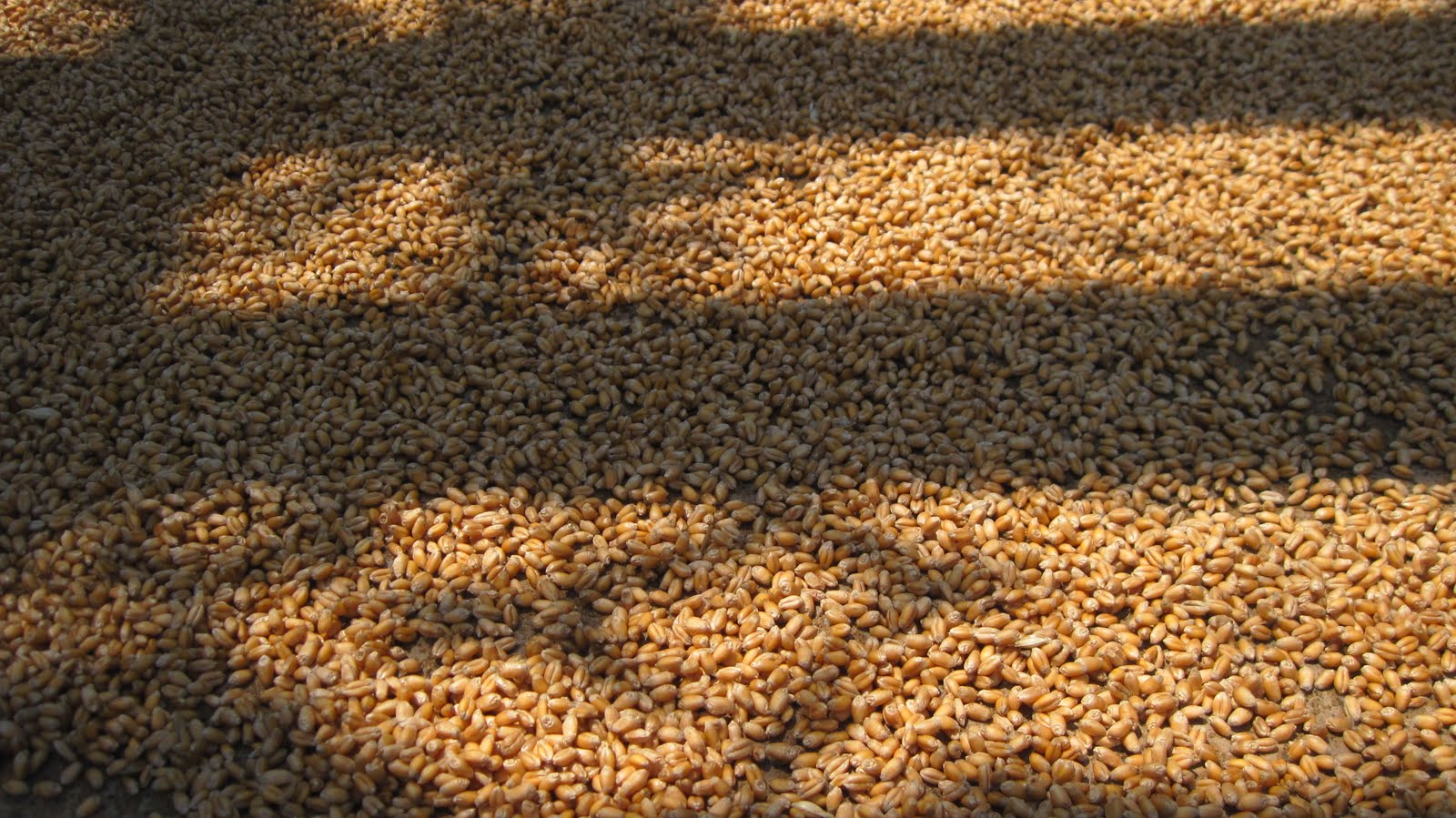
The separated wheat went into a bin, where it was washed several times.  The chaff and straw floated to the top, while the grains of wheat (wheat berries) sank to the bottom.  Then we spread the grains out to dry.
Sun drying wheat berries.
Ditto.

Soon we'll be able to grind it in the NutriMill and turn the flour into bread (or pizza dough).
"Wouldn't that have taken days by yourselves?" says Virginia.

Exactly.  With all this help and conversation, it was fun for all of us.

Friday, July 1, 2011

One-Third, not One-Twelfth

Someone stuck a summons on our front door a couple weeks ago, for me, to join a panel of peers at the courthouse.  Karen's been wondering why I haven't blogged about this, since I returned to Elk Cliff at 7:30 Wednesday evening.  She could tell right away my day hadn't been pleasant.

The prosecutor had finished his rebuttal about 3:30 and a couple hours later I was afraid the others, anxious to go home, one of them to work, would be throwing darts at me at midnight.  By the time I left the parking garage at seven, I was very grateful for the three jurors who had come to the same conclusion as I.  Hopelessly deadlocked, the judge called us "hung" and declared a mistrial.

Two days later, I'm confident four of us arrived at the "right" answer, although I'm sure some of the others think we wasted their and the government's time.  In fact, near the end, the foreman gave a little speech about how a hung jury would disappoint him, that it would mean our system of justice had failed.  I couldn't let that one go and added my own speech that, no, the system had worked just fine.  If the prosecution wanted to try again, and perhaps do a better job, it could do so and might learn from it, or it might decide the matter wasn't worth another twenty or more person-days of effort and learn from that.  Another fellow pointed out that one reason we require a unanimous verdict is to help prevent like-minded people from railroading a conviction or acquittal.

"Hmm," says Virginia. "I bet you voted not guilty."

Now why would she think that?  Was it something I said, the tilt of my head, a glint in my eyes?  Let me just say, one of the attorneys might regret not kicking me off the jury.  I would have bet I'd be one of the first disqualified.  If there's a next time, I'll probably disqualify myself if given the chance (as we were this time).

Words.  Recently I observed that the Federal Reserve Board writes regulations that contain more than 10 times as many words as the underlying statute.  If that's really necessary, it might seem peculiar that criminal statutes, and jury instructions, tend to be quite short, leaving lots of gray area -- especially when you consider the drastic penalties they entail.  Please don't blame other members of your jury who read the same words differently.