Sunday, February 27, 2011

Spring Garden Shots

In case yesterday's written description of our spring things left something to be desired, consider a few pictures that might be worth a hundred words.

First, the four-fifths finished fence of Elk Cliff Farm.  The plastic-covered pile contains the poplar rails we hope will disguise the 4x4 goat wire.
The prime purpose of the fence is to separate the garden beds from these guys.  By the way, we're expecting a few dozen more in a month or so.
Before we go behind the new fence, here's a shot of what we call the "field garden," which is found in our field across the James River Road.  I mowed it today and covered the southwest corner with black groundcloths and a green tarp to kill the Johnsongrass.  I plan to rotate the cover across the garden, where I want to plant sweet corn, sorghum, and grain for the animals.
 
Now, through the new fence into the middle of the greenhouse, 6 varieties of lettuce in this bed are close to table-ready.
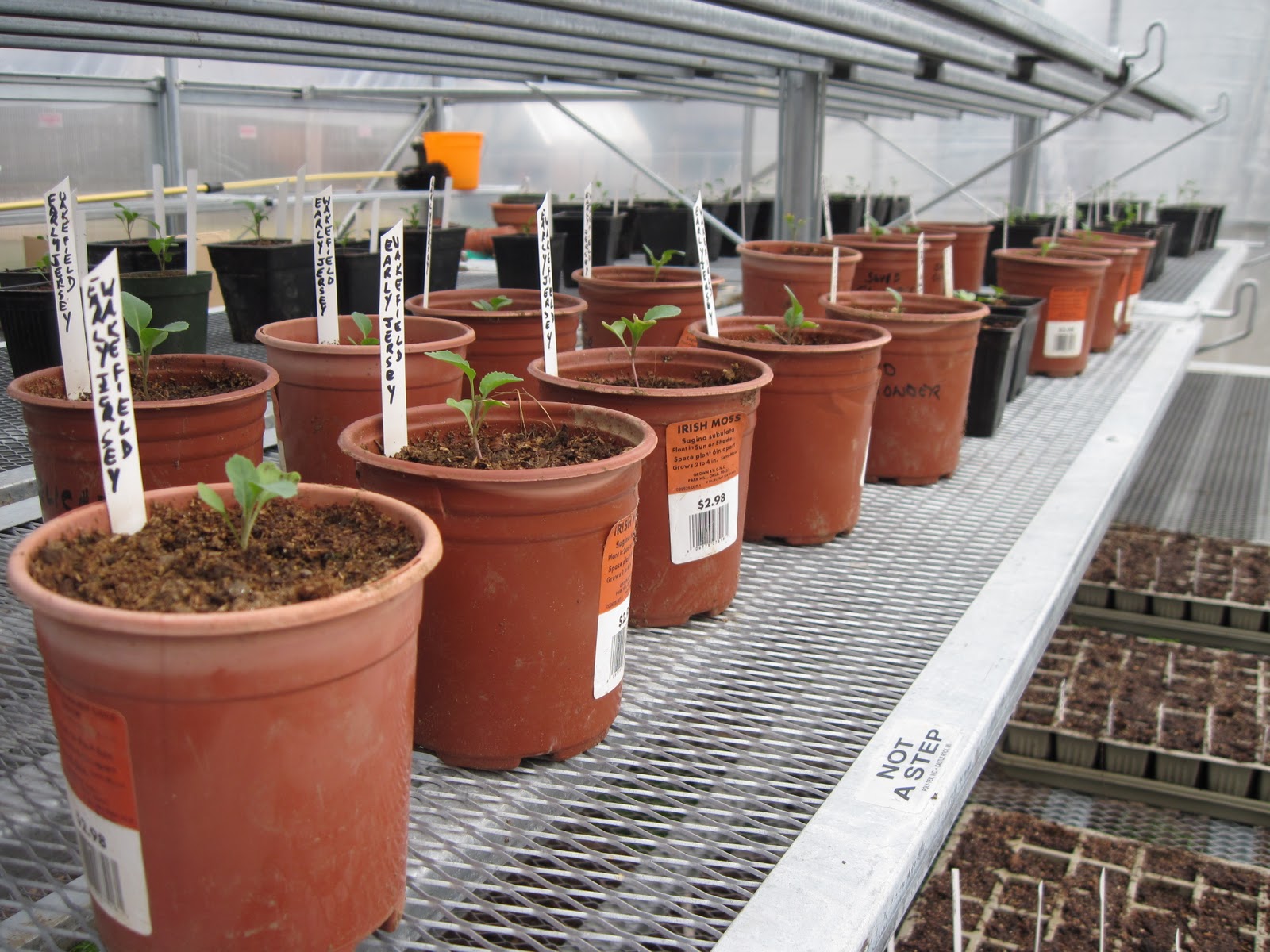
"Where is this bed?" asks Virginia, as if she doesn't know.  She's always thinking of others.  As I said, in the middle of the greenhouse.  My tomato flats with no sprouts yet sit on the lowest shelf, while broccoli, cauliflower and cabbage seedlings stand above at attention, anxiously awaiting their march to the outdoor garden.  The lettuces grow underneath these shelves.
  
Here's one of our winter wheat gardens, next year's flour.
More rows, garlic this time.
"Won't you please pick me this year?"  A few of last year's onions inquire.
 
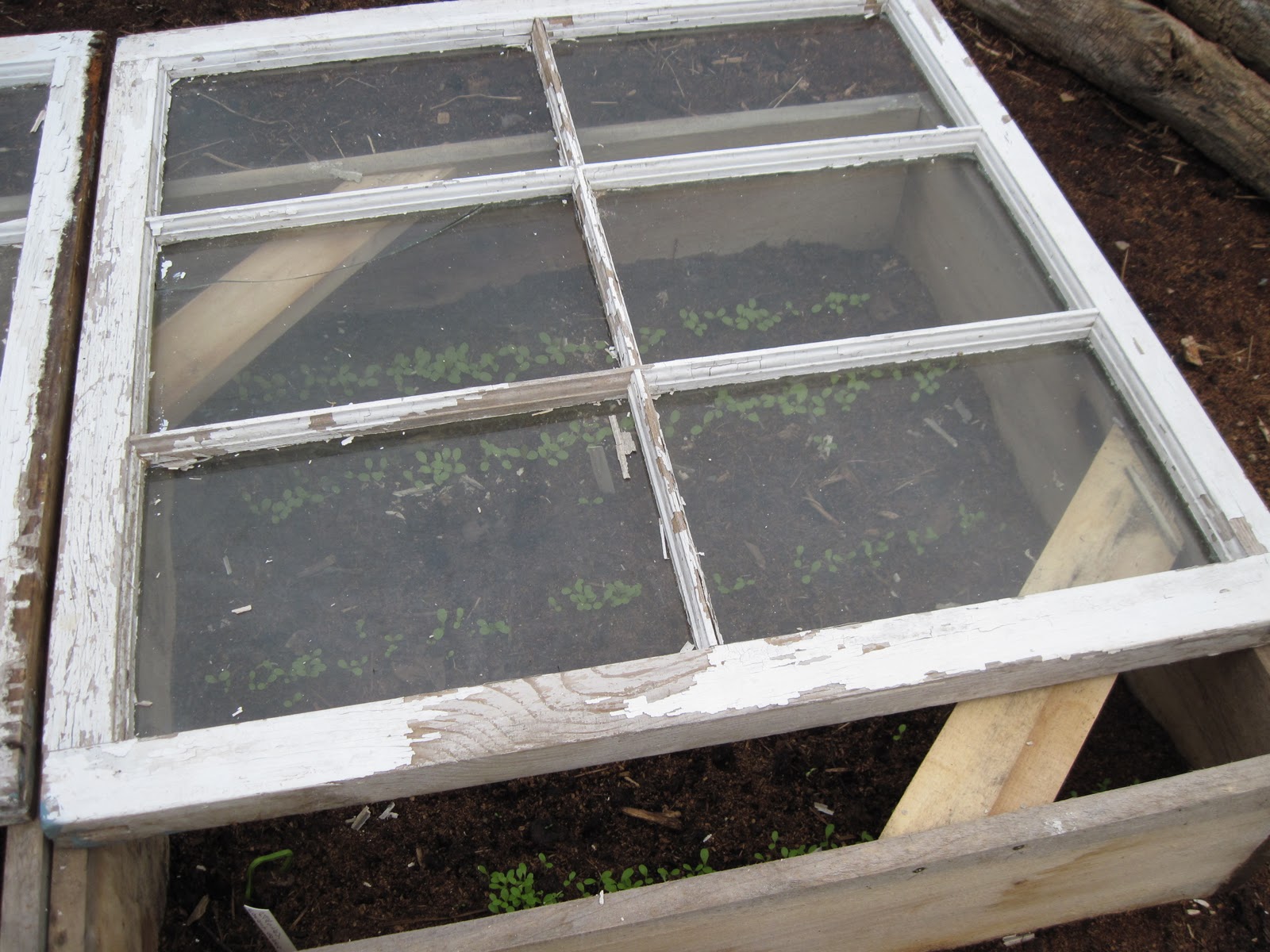
Lettuce grows in a cold frame.
Shall we say goodbye to this year's maple syrup season?  For how we prepared our 3 gallons of syrup, please visit Karen's blog, "Maple Syrup Take Two," at http://holesinmyjeans-kpannabecker.blogspot.com/2011/02/maple-syrup-take-two.html.  

Saturday, February 26, 2011

Spring Things

Things spring.  Our garden beds are taking off, head-started by plans laid in late Fall for once, instead of delayed by unrelated time-eaters and wet weather.  Rain, rain, come again today, this year we're ready for you. Whenever you aren't visiting, more seeds are likely to be planted.  This is when I'm especially grateful to be self-employed.  I don't have to go to an office and watch fine weather pass by.

Each year I surround one bed with garlic, planted in November.  The cloves develop underground, sight unseen, until they begin to poke out in January or February.  Now they're 3 inches tall, as they should be.

It's the onions' turn.  Their bulbs wait under a few inches of mounded soil.  Actually, I doubt they're waiting.  Planted three weeks ago, their hairy roots probably are reaching down and around, while green shoots aim sunward. If I were a scientist, I might dig here or there to see what's happening.  Instead, I'm reluctant to sacrifice a single sprout.

Lettuce in the coldframe races to catch up with greenhouse greens almost ready to grace our table, while tiny lettuce and spinach seeds in the garden should be sprouting tiny thin first leaves any day.  Every few weeks I'll be planting a new generation and as the heat of summer approaches I'll gamble on greens thriving in the shade of an ash tree.  If we're lucky, we'll have home-grown salads year-round.

A year ago I planted fava beans too late, thinking they grow like green beans and limas.  They burned black in the summer sun.  This year, their wide fat seeds have already been sown.  Maybe they'll grow, this fava bean virgin wishes.

"Peas, peas, peas, peas, eating goober peas," sings Virginia.  "Goodness how delicious, eating goober peas."

Well, it's too early to plant goober peas, but Wando and Laxton's Progress peas are doing something underground.  I hope to be shelling several bushels in 3 or 4 months.  I know, sugar snap peas and snowpeas are cool.  I plan to stick some of those in the soil later, far enough away and late enough not to cross with the shelling peas.

All of this reminds me of the one class I took from my father, Genetics.

Wednesday, February 23, 2011

Synapses

Before I drove my mother to her dentist appointment this morning, I asked where the dentist was located.  I forget exactly what she said, but after she named a few nearby landmarks I caught on.  "Behind the A&P?" I suggested.  "No," said she, "next block over, behind...." "Oh," I said, "I meant behind the newer A&P, now Family Dollar."  Exactly.

That's how conversations go between old-timers.  Newcomers might not know what we were talking about, but we remembered the A&P grocery store's location on Main Street, near the theater, as well as its next location on Cherry Street.  A few blocks away was the store's competitor, IGA, oops, Dave's Market, or rather, now the Community Market.  This kind of thing helps liven up a visit to what used to be home, whether Bluffton, Chapel Hill, Northern Virginia, Baltimore, St. Louis, or Salisbury.  Snapshots, sometimes movies, accompany each return with increments of the past.

Wandering about town with my mother is like entering a Clue game board, or maybe Trivial Pursuit.  Vaguely familiar faces jog recollections, usually less than half right.  Maybe I guess a last name, maiden names for females.  The first name, if one comes to mind, is likely to be off by a birth or two, sometimes even a generation.  A friend of mine says he hates to "go home" because everyone looks so old.  Someone seen everyday, including a mirror's reflection, doesn't look nearly as old as a remembered face 40 years later.

During Monday's lunch, we sat with two women, my former piano teacher and the former organist of my childhood church.  Starting with their children, we branched out to other teachers and students, mostly with a musical bent.  I felt like a Boy Scout at a shooting range, taking wild shots at the beginning then steadily moving into the bull's eye.  I amazed myself by pulling names out of thin air, people who had vanished from my life forty years ago.

I'm not sure Mrs. Szabo believed me when I told her she had taught me one of the most important business lessons of my life.  I was at least 20 minutes late for a piano lesson because my voice teacher had run late.  "I figured you weren't coming," she said from her desk, looking as if she'd moved on to something else and I was interrupting.  Intimated by professors, she and he, I said, "I'm sorry, but my voice lesson ran over."  "You have a responsibility, too," she said sternly, "if he runs over when you have a lesson with me, you need to tell him and reschedule with him if necessary."  Today's Mrs. Szabo laughed, "Me, stern?"  "Definitely," I said, "we thought of you as being very stern, and your comment stuck with me forever -- 'you have a responsibility, too.'"

John Murray stopped by our table on his way out.  "Do you remember me?" he asked.  "Sure do," said I.  "You raced across the cornfield one day to bawl me out for setting off an M-80.  I climbed a tree and you found me."  Remarkably, he proceeded to recite the same story he told me that day, maybe 50 years ago, about the fellow who had seriously wounded himself lighting a firecracker.

"Sounds tiring," says Virginia.

She's right.  Working my memory like this is like sightreading music for 4 hours at a stretch.  Naps are welcome.

Tuesday, February 22, 2011

Circles in the Snow

Because we've missed out on much of the white stuff this season, I rode Amtrak north in search of some.  Pleased to find that every seat had access to an electrical outlet, I worked on a book update until dinnertime, although I frequently glanced out the windows.  One of the first things you notice riding a train is people don't pay as much attention to the back sides of their houses as they do fronts, which shouldn't be a surprise, I suppose, because it's also clear, as passengers pass through the aisles, the same is true of their bodies.  Another thing I noticed was lots of train whistles.  "A train's coming!"  A bit slow on the uptake, I had to remind myself that it was our whistle.

The prettiest part of the trip was Virginia, with all the little hamlets nestled in mountain hollows, and farms, orchards and vineyards.  By the time we reached West Virginia, after a layover in D.C., the sky was turning dark.  I realized I might as well stay put because the views from the observation car wouldn't be any better.  The sounds might have been, because the elderly gentleman across the aisle, who must have slept 90% of his trip, made no attempt to disguise a variety of noises.  Perhaps he left his Z-Pak at home.  Not for the first time, I wished I'd reserved a berth in the sleeping car.

As soon as I returned from a tasty vegetarian pasta in the dining car, my neighbor in the window seat pointed out that it was snowing.  I said, "That's interesting.  It was raining outside the dining car."  She laughed.  A few minutes later, when the snow changed to rain, I said, "See?  The rain finally made it to our car."  She laughed again.  It's nice to have an appreciative audience, except she apparently figured I wasn't really working and began offering enough information to make me hope she'd reach her destination soon.

By the time we sighted Lake Erie the rain had turned to ice and snow.  Two hours later, when I disembarked in Toledo, the roads looked a mess.  My sister showed up a couple hours later, finding me half asleep on what I'd turned into a long vinyl couch.  "Here I am, picking up my homeless brother," she said.

"You've been into first impressions this week, haven't you?" says Virginia.  "Remember when your friends from North Carolina showed up on Friday.  You hadn't shaved in 3 days and had mud and ashes splattered over your clothes and face."

Nothing a shower and "Queer Eyes for the Straight Guy" can't fix.  Whatever, I had found my snow, I thought, until my sister assured me we'd be out of it in 15 minutes.  Sort of.  A few hours later it began falling heartily in Bluffton as my mother and I watched from her apartment living room.  We drove slowly to dinner with Mary and Fred, and then even slower after I watched a van carve a circle in the snow in front of their house and a couple guys push her back on course, not really what I had in mind on a day of 70 degrees at home in Virginia.

Thursday, February 17, 2011

Waiting for the Kids

We're waiting for 8 does to deliver babies.  What's the excitement?  Well, first off, it's great fun to be present when a tiny kid breaks out of its bubble and within minutes begins to walk.  Human parents are lucky their kids aren't as athletic.  It's usually enough of a challenge for mom to feel like walking around the block.

To be selfish for the moment, which I suppose is most of the time, not just a moment, I look forward to 2 weeks or so after the first birth, when our refrigerator resumes storing a bountiful supply of fresh milk.  No more skimping on cereal, or mixing what grocery stores call "milk" with the small amount of real milk Karen brings in from Polly, the doe we save as dessert for Witty, our premier buck.  No more drinking water after a run instead of mixing a healthy dose of chocolate syrup into a glass of raw milk.  No more restraining myself from stepping into TeePee's (a/k/a The Trading Post) for a pint-sized half-gallon of Hershey's ice cream, when we can churn our own.  No more retrieving a wheel of aged cheese from the basement without replacing it with a new block.  And no more frozen mozarella when Karen can whip up a new batch in less than an hour, followed by ricotta to boot.

This time of year bodes well for the table in other ways.  Soon the asparagus will be sprouting.  The lettuces in the greenhouse are getting closer to harvest every day, and we now have more lettuces sprouting in a cold frame.  I planted spinach yesterday in the outdoor garden, and earlier, peas and onions.  As we finished putting wire on the new garden fence today, we couldn't help trampling a few tender garlic shoots.  Tomorrow I'll transplant broccoli, cauliflower and cabbages into larger pots, and soon after, into the garden.

"So you finally finished the fence?" asks Virginia.

Finally?  It was beginning to seem like forever, but we only started the fence a week ago.  Our Spring-like weather gave me the itch to plant, so the fence had to be scooted along.  It's actually not finished yet; 3 gates remain.  If I'm lucky, Karen will build them while I convalesce for a few days in Ohio.  Sort of like when a toilet won't stop running or a faucet dripping -- I can disappear for a few hours and come home to fixed fixtures.

I almost forgot to mention that another "kid" was born today.  The Arrowhead Trio dedicated over an hour to practicing the first movement of the violin, clarinet and piano trio I've been working on.  Tentatively titled "The Barnyard Trio," we got to hear "The Hawk's Visit."  As Winston, our violinist, put it this morning, "Getting to hear live instruments play a new composition you've written is like pouring your own freshly-made maple syrup on a pile of pancakes."

Wednesday, February 16, 2011

More on Growth

Let's return to the idea of growth, which includes a variety of concepts.  Andy Kessler says an "economy" is a "system that increases the standard of living of its participants."  He offers examples of technologies that have increased our standard of living, such as Dell PCs, Apple products, animated films like "Toy Story" and "Schrek," Oracle databases, Microsoft spreadsheets, Intel processors, Google search engines, Facebook, eBay, Amazon.  Going farther back, he points to the steam turbine, vacuum cleaner, electric dishwasher, X-ray tube, flash-freezing process, refrigerator and air-conditioner, and microwave oven.  All of these developments disrupted the status quo and many helped us live longer and better.

"Us."  You and me.  Whether they have helped mankind live longer and better has yet to be determined.

Maybe you've heard of "singularity," the cover story in Time last week -- "the moment when technological change becomes so rapid and profound, it represents a rupture in the fabric of human history."  Raymond Kurzweil and others picture the moment when computers become more intelligent than humans, and humanity will be transformed.  Kurzweil, whose name is on the electronic keyboard that in some ways freed this pianist from reliance on sometimes klunker pianos, predicts this moment to occur by 2045.

If true, computers will be able to do everything we do, but better, including composing music, writing books, painting pictures, inventing things, and carrying on dinner conversations (while they eat who knows what, or not).  What could this do to humans?  Our roles on Earth or wherever we live would drastically change, science fiction become real.  There we are, 35 years from now, with artificial intelligence a fact of life, and death, illness, and old age "cured" by superior intelligence.  What do we do?

Some say this will never happen, that the human body is not a purely bio-chemical system that can be manipulated into perpetual existence -- or that can be simulated and reverse-engineered into a computer. 

"Whatever," says Virginia, "we're still in charge of our fate."

I think she's right, and we're responsible for defining what an "increased standard of living" is.  I'm not ready to give up the conveniences technology has brought us, but I'm also unwilling to declare that they have improved our standard of living, speaking in solidarity terms (that is, in terms of humankind, past, present and future).  Among other things, they may have brought us to the edge of the precipice, what some religionists welcome as the "second coming."  Where will growth take us next?  The persons with the right answers might save humanity, they might become the next billionaires, or they might walk us over the cliff.

Tuesday, February 15, 2011

The Fence and Maple Syrup Duet

I smell maple syrup.  As I continued working on post holes, Karen and Susan began evaporating the 100+ gallons of maple sap we've collected so far.  I write "so far" for two reasons.  One, the buckets still hang on our trees.  Two, the result of today's evaporation will determine whether we drink the sap, offer it to someone else, or keep boiling it.  The answer to the boiling question alternated among maybe and no throughout the day.

The big problem is we don't have a proper evaporator.  A lot of the heat from the wood being burned rose around the too-small evaporating pans and warmed the atmosphere instead of the sap.  The women kept a fire going all day in the fireplace that's part of our outdoor kitchen.  We rarely use that grill, unlike the adjacent brick pizza oven.  Susan brought leftover lumber from her place and Karen gathered fallen limbs from ours.  Gradually, they learned to keep the fire the right temperature so the sap wouldn't simmer too slowly or boil too fast. 

I checked in now and then, hoping to smell and taste fresh maple syrup, and be a cheerleader.  Right, I probably doused more enthusiasm than I offered cheer as I grumped my way along the final 17 holes.  Each of the first 7 greeted me with 6 inches of hard, tight gravel mixed with clay.  After banging and twisting the tamping bar, the post hole digger rewarded me with tiny clumps.  Fortunately, it took me only an hour and a half to finish the last 10 after suffering 4 hours on the first 7.  Meanwhile, during water breaks, I noticed the sap gradually turning darker and darker, clear to yellow to tan to brown.

My mood substantially improved after the post hole digger returned to the barn.  Instead of lying in the sun, as I had dreamed of doing, I planted more peas -- Wandos and Laxton's Progress -- and shooed a few chickens that had creeped into my territory, soon to be enclosed by a fence.

I joined the fire-tenders for while.  The sun slid behind our mountain, Susan claimed a pot-full and took it home to finish, while Karen needed a flashlight to check the remaining sap's progress.

"So what's the answer?" asks Virginia.

I'm getting there.  I heated up some leftovers for dinner, then headed off to orchestra practice.   When Karen said, "I'll probably still be here when you get back," I had an inkling of the answer.  When she wasn't there when I got back 3 hours later, I thought I might have been wrong.  I opened the back door and the odor of maple syrup greeted me.  Karen was finishing it off on our indoor stove.  She offered me a taste and, if I heard correctly, she's not ready to let the rest of the sap go to waste.

Monday, February 14, 2011

Fence-Building

This blustery afternoon kept us alert for flying objects, such as the roof of our chicken tractor, which refuses to stay where it belongs.  The sun was warm enough to offer suntans, and I couldn't help wondering what the northern wind portended.  Our low was about 50 last night, so the maple sap ran free, offering us about 24 gallons this morning.  The wind slowed the flow to 16 more this afternoon.

I invested my Valentine's Day in post holes.  First time around, most of them did not meet standard, so before sticking in 4x4 posts, I've had to deepen them to 30 inches.  The last few inches tend to be clayey or rocky, and not much fun.  Seventeen more await finishing tomorrow.  Then we'll install the wire fence along the inside.  We'll prettify it soon with wooden boards on the outside.

The main purpose of this fence is to keep out the chickens.  Let's hope the fence, accompanied by regular feather trimming, does the job.

"What were you doing, playing in the dirt today?" says Virginia.  "I saw you take a break."

My resolve to delay spring planting until the fence is finished fell apart, twice.  Three days ago I planted peas (Wandos).  Today I planted onions.  These will assure prompt completion of the fence.  Oh yes, I've got to build some gates, too.

Saturday, February 12, 2011

Sanctuary

On Monday we saw the end of hog butchering (see "Bless this Hog," February 7).  Today we saw the beginning, not quite the beginning, although we heard it.  Our role was to help with the scalding, hair removal, and hoisting of the clean "hog on a pole."  I think our host expected all of us to yell "hog on a pole" when we reached that step.  He said it alone, without a cheer.  Mostly we watched, glad our roles were not reversed.
Our instructor claimed we were engaged in the olden way, the way this has been done for many years, with little change, to be distinguished from the way it's now done in factories and slaughterhouses.

As on Monday, I left the place unsettled.  Returning to our driveway was like entering a sanctuary.  I breathed a sigh of relief and felt grateful for plants.  Do they scream when they're picked or pulled?  Just yesterday, a friend promised that if you lie between rows of immature corn in quiet summertime, you could hear it grow, along with crickets crunching.  I doubt what you hear is a hum or a sigh, certainly not enough to suggest a scream when picked, although tearing off an ear makes a noise.

Why was home peaceable?  Over there, in clear view, was the turkey killing tree.  Have the wind, rain and snow, or simply time, purified the atmosphere, like exorcists?

"Nonsense," says Virginia, "the remoteness of events answers the question.  No aura, no spirits."

Will we raise a pig?  I don't know.  It could be the best way to prepare my field garden, which continues to baffle me -- not because I don't know how, but because of the time it requires.  I could invite a tractor for a visit, or a pig.  Maybe we should try the goats first.  Having made fairly quick work of the post holes for my other garden fence, which I hope to finish this next week, I may consider knocking out another 50 holes around the field garden -- and then setting up paddocks for the rest of the field.  Good exercise.

Friday, February 11, 2011

Tapping Local Resources

We finally took Larry's advice.  We tapped some of our sugar maples.  Walk by a tree and you'll hear drip-drip-dripping until it gets too cold this evening.  It'll resume in the morning after the sun warms the trees.   We'll keep an eye on the buckets, empty them as they fill, and briefly store the sap in shiny new metal garbage cans.

Thanks go to Susan, who brought wood for the fire on which her pans will boil the sap down to syrup, and to Pat, who contributed a bunch of Fresh Step cat litter buckets.  Karen bought a few old-fashioned metal buckets and spiles with hooks, so a couple trees look classy.  She also cut a copper pipe and a PVC tube into 3-inch pieces, to go with the tacky plastic buckets.

They seem to work equally well, the tacky and the classy, as usual -- which reminds me of Burberry scarves for some reason.  Without a Burberry coat, what's a Burberry scarf?  Sort of like a Mercedes with a dent in the side or a broken turn signal lens -- proof that you can't afford the car.

This also reminds me, for some reason, of yesterday's blog ("Keep $$ Local"), which so far hasn't drawn anyone's wrath.  I'm serious, we could have a movement here.  If you're truly upset with giant banks, the kind whose failure could have a systemic impact on our financial system, and you think Congress isn't doing anything to stem their growth or continued existence, walk your money home.  If enough people did this, no bank would be "too big to fail."

"It may remind you," says Virginia, "but what possible connection is there?"

I guess whenever I think of harvesting maple syrup, I think of growing vegetables, milking goats, making cheese, and doing all those other things most Americans used to do at home.  Doing them these days is like money in the bank.  Back then, folks didn't send their money (they probably didn't have any to send) to faraway places and unknown people.  They'd either stick it under a mattress, earning about as much interest as banks pay us today, or trot into town to visit George Bailey.

[By the way, this is my 400th blog entry.  Should I continue?]

Thursday, February 10, 2011

"Keep $$ Local:" Too Big to Fail -- What We Can Do About It

We -- you and I -- share responsibility for "too big too fail."  You know, the idea that certain large financial institutions are so important to our financial system that the government must not allow them to fail.  I've heard and read a lot of griping about this, but unless we already limit our financial dealings to the smaller firms, we're adding to the problem.

Financial reform, through the Dodd-Frank Wall Street Reform and Consumer Protection Act, is supposed to take care of this -- so taxpayer funds aren't used again to bail out the big guys.  Maybe Dodd-Frank will solve the problem, maybe it won't.  We can leave that argument for others to fuss about.  In the meantime, we're not completely powerless.

Since the bailouts, we've watched big institutions swallow more little ones.  We've heard about their big bonuses.  We've seen them mishandle mortgage servicing and foreclosures, by using robosigners and being unable to produce supporting documents (such as the promissory notes signed by borrowers).

Yesterday, JP Morgan Chase Bank apologized to active military service members for not paying attention to provisions of the Service Members Civil Relief Act (SCRA), which requires lenders to lower interest rates to 6% and refrain from foreclosing (after becoming aware that customers are on active duty).  This isn't rocket science.  Banks have no excuse for not understanding the SCRA and other laws.  They've been bombarded with articles, book updates, and agency issuances on these topics.

We can complain all we want about bungling by the big guys, to little avail, or we can do something about "too big to fail."  What institutions handle your financial affairs?  Big ones or smaller, local ones?

If your answer is "big ones," then move your money.  Bring it home to firms you know and trust.  And keep an eye on developments.  If a big firm buys the small one you've been using, move your money again.

"Hey, a grass roots revolution!" says Virginia.  "We have the power.  We can do something."

We certainly can try.  We may be surprised by the products and services available through small institutions.  They've changed over the years, and now offer most if not all of what the big ones offer, at least for people like you and me.  Check out your local banks and credit unions.

"What about mortgage payments?" says Virginia.

Well, you might not be able to do much about them.  If you borrowed from a local firm, it may have sold your mortgage loan to a big firm.  Even if you refinance, that loan might be sold, too, although you could shop around for a firm that says it doesn't plan to sell its loans.  If enough people demanded this, the market would have to change to accommodate it.

We've seen "buy fresh, buy local" take off.  How about "invest local, keep your $$ local?"

-- Get rid of big name credit cards.  Keep $$ Local!
-- Move your checking and savings accounts.  Keep $$ Local!
-- If you must finance a car, home improvement, whatever, do it nearby.  Keep $$ Local!
-- Refinance with a community bank, savings association, or credit union.  Keep $$ Local!
-- Bring your stock and bond investments closer to home.  Keep $$ Local!

Of course, you can write your legislators, too.  But don't forget.  Put your money where your mouth is.

Wednesday, February 9, 2011

A Day in the Life of a Writer Who Has Caught Up with Deadlines

The greenhouse thermometer read 30 degrees this morning, versus an outdoor temperature of 23.  I'd like to think the manure pile in the greenhouse is making a difference, but I suppose the gauges could be faulty.  The warmer days are helping my 10 varieties of lettuce grow faster than they were.

I'm getting into a habit of every third day stopping by the woodshed to practice using the heavy-duty splitting maul I ordered from Lehman's a few years ago (http://www.lehmans.com/store/Stoves___Wood_Cutting__Splitting__and_Hauling___Heavy_Duty_Splitting_Maul___12450), well worth the $50 investment. My lessons began with the black walnut tree cut down by request of the family of the fellow who ran into it on May 10, 2010.  I probably could have dropped the maul on a walnut chunk and watched it split, but I needed to perfect my aim and my swing because a pile of locust waits for me.  A month ago, I gave the locust a try and failed miserably.  Now I've graduated and am able to add some of that yellow wood, nicely split, to our backstairs bin.

After emptying my cup of apple cider vinegar tea and doing a tiny bit of work "in my office," it's usually time for a morning run.  Last night I realized our bank account was dwindling, so this morning the bank was my destination.  "You still running?" the teller asked, not impressed by the stocking pulled over my face and the pistol in my hand.  "Always, unless I'm injured" was my answer.  The branch is a little more than 3 1/2 miles from our house, so I added a detour to make an 8-mile loop.  As I left Glasgow, Randy waved from his garage, which is stuffed full of things he's trying to sell.  "Since we built this house, we've parked a car in the garage twice," he told me,  "been admiring your greenhouse, started plants myself last year, we'd like to drop by for a tour some day."  Please do, I said.  A few years ago we traded sweet corn for green peppers.

I read the local weekly over a late breakfast, then resumed what I started yesterday -- garden fence building.  Because I dug 17 holes yesterday, I had to match that today, leaving only 16 to finish, tomorrow I hope.

"To keep out the deer?" asks Virginia.

No, the chickens.  My little yellow mesh fences, mentioned in earlier blog entries, haven't worked well except for the first few days after we trim wings.  I figure a 6-foot fence will do a better job and reduce feather-clipping to a monthly task.  The fence will only extend along two sides of the garden area.  Let's hope the chickens don't wander all the way around.

Tuesday, February 8, 2011

Day After

Let's reprise January 27, 2010, when I blogged about the old Natural Bridge High School track.  I often use the track for speedwork.  This morning I wanted a short relaxing run after spending all of yesterday standing on a concrete floor.

Of course, before we enter, we must buy tickets. 
All right, now read the rules.  You've gotta look up, way up. 
Believe it or not, that's a new sign.  Its use of the term "joggers" reminds me of runners 20 years ago who looked down on "joggers" as fly-by-night and casual.

Before we start our laps, let's check out the schedule.
All right, first time around, admire the scoreboard.
"Those were the days, my friend," sings Virginia.

They were days, maybe not "the days."

Now this is new.  I don't know what it is, maybe for lacrosse.

On the way home, firewood envy struck.

By the way, we had salad for dinner last night, and I'm still wondering when/if I'll want to eat any AVH (Arnold's Valley Hog). Karen worked on the sausage today while I dug post holes for a garden fence.

Monday, February 7, 2011

Bless This Hog

[Caution:  Viewer Advisory -- Discretion Suggested]

We spent most of today with this fellow, Arnold's Valley Pig, who enjoyed his life just down the road.  I'm pretty sure my decision to post this picture was more difficult than choices made by war photographers.  Unfortunately, we're used to them, but not this, although 10 billion -- that's right, 10 billion -- animals are killed to adorn our tables each year in the U.S.
He wasn't squinting when we saw him alive, rooting through the back of our friend's pickup.   He also wasn't sweet and affectionate like a goat.  We discovered tusks growing under his snout, not that that's relevant to anything.

Some people, including Tommy and Sophie, claimed his brains will be tasty with scrambled eggs.  While I'm not up for that, I'm glad very little of what's left of this former life is going to waste.  I didn't know jowls offered bacon, but they do.

Frankly, until this morning I didn't know where most pork cuts come from, and I pictured butchering as a very bloody process (even though I've helped process turkeys and chickens).  I learned it is not.  My first job was to butterfly-cut a rack of pork chops.


Why is this man smiling?  Three reasons.  One, he's known for smiling.  Two, that's what we often do in front of a camera.  Three, he's remembering an early morning in Vernazza, Italy, when he sat on the balcony of his rented flat to watch the town wake up.  A man in a white apron scurried down steps leading to the town's narrow street of shops, a quarter like this one hoisted over his shoulder.

My biggest job for the day was separating the skin and bones from this leg and another one, while Rob, at the next table, did the same thing.  The rest of our crew cubed what we cut off and tossed them into baskets lined with black plastic.  All of this became sausage.
How much fat goes into sausage astonished me, and coated our hands again and again with grease as we mixed and mixed and mixed.  That process took quite a while because our teacher had to pause and cook a patty now and then to see if the seasonings were just right.
"Did you put it in plastic rolls?" asks Virginia.

No, our boss makes it into thin, flat sheets and freezes them, one-by-one, in plastic Glad bags.  Before that happens, the sausage needs to sit overnight and absorb the flavors of sage and other seasonings.  Karen will return tomorrow to help wrap it up.

Sunday, February 6, 2011

Wildcat Mountain Hike

We celebrated this spring-like afternoon with a couple friends hiking part-way up Wildcat Mountain.  My legs were a bit tired after running to Arrowhead Lodge and back this morning.

We took the camera along.  I'd include some pictures if it hadn't stayed in my water bottle belt the entire time. 

We saw no bears, so we talked about bears.  I imagine plenty of them saw us.  We didn't hear them talking.

Part of the forest road had a freshly applied coat of gravel, which worked up my tree hugger instincts -- to no avail.  We saw no evidence of recent logging activity.

One of the hikers suggested I read "God is Not One -- The Eight Rival Religions That Run the World -- and Why Their Differences Matter" (Stephen Prothero).  He says the book debunks the idea that "the essential message of all religions is very much the same."  This may be a "lovely sentiment," "but it is dangerous, disrespectful and untrue."

"I don't know much about Islam," says Virginia.  "Maybe I should read the book."

Our friend also mentioned a native American woman who said native Americans tend to look at strangers as they look at family and friends, whereas other Americans look at strangers with fear and distrust.  Maybe, maybe not.  I don't like stereotypes because they don't treat individuals as special; they put me into categories, some appropriate, some not.  Target marketing pieces that arrive at our door get tossed into the paper shredder for future compost.

Good hike.  Good ideas.

Saturday, February 5, 2011

Preliminary Thoughts on Growth

Go east, south, west, if you want growth -- to China, Turkey, India or Brazil.  We seem to be maxed out here at home in the U.S.

"But the stock market," says Virginia, "it's up, what, 20% in the past year?  Isn't that a good sign?"

It feels good, maybe, so long as we forget the high unemployment rate, all the people who've given up looking for work, the low rise in our gross domestic product (GDP) compared to what we used to see, the fact that many of the companies in the Dow Jones Industrial Average or other market averages earned half their revenues overseas, and our huge national deficit.  A lot of psychology runs the "market."

"Retail sales were up last month, right?" Virginia adds.

I guess so.  Where did the money come from to buy those things?  I read somewhere that our savings rate clicked downward, folks drew on money market and investment accounts, while incomes lifted a tad.  Maybe we're "recovering" from the concern about over-extension we had a year ago and we're ready to resume our bad habits.

Some "experts" say economic data has become more volatile and we should expect more frequent recessions in the next decade or two, say every three years or so.  I guess recessions are likely because our growth rate is so low.  It wouldn't take much to tip it below zero now and then...a recession.  We can't count on growth to bring in more taxes to pay for higher government "investment," so we'll: (1) go deeper into debt; (2) raise tax rates; and/or (3) cut government programs  

Something's got to give.  A serious attitude adjustment is in order.  Ordinary Americans will need to revise our expectations.  So much for the sizable salary raises we used to expect.  Goodbye tax breaks.  We may need to save up for things we really want, which will give us time to decide whether we really want them.

"Keeping up with the Joneses" may take on a different flavor.
     -- "Hey, how about a coupon exchange, I brought my scrapbook along?"
     -- "I'm glad we raised an extra hog; we'll trade sausage for sweet corn."
     -- "I've done that before; here, help me split this pile of wood, then we'll build your fence."
     -- "My mower broke; I'll give your child piano lessons if you'll mow my lawn."
     -- "Wow, your garden looks great; what did you do to keep the cabbage worms away?"
     -- "You know, I thought about applying for that job, but it made more sense to work at home; I don't need a car and gasoline to gather sap from our maple trees and expand the planting -- besides, the exercise is good for me...and I won't need a new wardrobe."

"Definitely sounds retro," says Virginia, "while the Egyptians say 'stick-it-to-the-man,' we could support each other.  Think 'victory gardens' times ten."

Or a thousand, this time permanently -- unless a post-information technology revolution comes along, created by a new generation of innovators.  Go kids, go!

"The reasonable man adapts himself to the world.  The unreasonable one persists in trying to adapt the world to himself.  Therefore all progress depends on the unreasonable man."  George Bernard Shaw

Friday, February 4, 2011

We're Spoiled (and Stuck)

As folks scramble to cope with homes and schools that aren't warm, the suggestion that we pile on clothes and blankets instead of buying generators and installing other back-up heating devices has a certain appeal. I realize it's not an answer for everyone, especially those with less than perfect health, and it won't keep pipes from freezing.  I'm afraid I was kind of drawn to the governor of Pennsylvania's criticism of the cancelling of a professional football game due to weather ("you wimps") -- that he didn't think would have happened in certain other parts of the world.

"We're spoiled," says Virginia.  "We have to be able to run around naked indoors in the winter and fully clothed in the summertime."

I'm tempted to read "Air-Conditioning America" by Gail Cooper or "Cool Comfort: America's Romance with Air-Conditioning" by Marsha Ackerman, which I understand examine how HVAC technology transformed American expectations and the definition of comfort.  For most of time, humans have managed quite well without heated or cooled homes.  Now we've designed ourselves into them.  We're stuck.

One of these days, not today, I want to return to our obsession with growth.  For example, we refuse to invest in companies that don't present us with the expectation of above-average growth.  We view a country as a failure if its GDP doesn't grow as fast as those of other countries.  Inherent in this growth obsession is a tendency to get stuck -- in that we make it virtually impossible to return to a previous, perhaps more reasonable state, because it's "primitive" or too much like the life of "pioneers" -- and at the same time we also might be making the return inevitable because our lifestyle becomes unsustainable on Earth (i.e., a Catch-22).  I think a very serious paradigm shift is inevitable.

"I think you lied when you said 'one of these days, not today,'" says Virginia.  "It's still today."

All right.  Goodbye, folks.

Thursday, February 3, 2011

Doing What You Want

Don't procrastinate!  As I check off writing deadlines one by one, doing the work that brings in the bacon, I think of the poems, stories, music and other stuff that doesn't get written or done.  How many of us postpone doing what we say we want to do while slogging away at something else?

"Who are you to talk?" says Virginia.  "You don't need to hustle off to an 8-to-6 job, risk getting fired if you don't, or struggle making ends meet payday to payday."

She doesn't really know, but I'd have to admit, like many if not most people my age in this country, my situation isn't the same as the majority of twenty- or thirty-somethings.  It's tough for the strugglers to find time to do what they really want, although I think they can.

The first step might be to convince yourself that you really want to do what you want to do.  Frankly, if you're not finding time to do it, you probably don't want to do it enough.  Think of what you find time to do.  Sketch out your day.  Sleep as late as possible? Clean house?  Mow the lawn?  Sit and talk to strangers while your laundry spins?  Email, "talk" on Facebook, watch television, play golf?  All those things are perfectly fine activities, but if they're not that thing you really want to do, then what's up?

Next, focus on what you're missing.  A writer, artist or composer knows he or she forfeits product each day that passes without practicing the medium.  Ideas disappear or fail to appear in the first place, and then they're gone for good.  If a writer writes, he or she has something to show for it.  If the writer doesn't write, there's zip.  Some day, looking back, he or she may say, gosh, if only I'd....  The same is true whatever you want to do -- knitting, learning automobile mechanics, singing, walking, exercising, starting a business, growing a garden.

That's enough.  I'm going to work on that trio.

Wednesday, February 2, 2011

Pinching Off the Extra Seedlings

I bit the bullet this morning and pinched off the broccoli, cauliflower and cabbage seedlings growing in our bedroom window so only one seedling remains in each cell of the planting tray.  I usually wait longer.  Why?  I guess to see which of the 3 or 4 seedlings in each cell is the most robust, but I suppose the longer I wait the more each one stunts the other's growth.
Growing instructions typically call for 3 or 4 seeds to be planted in each cell, supposedly in case a low germination rate occurs.  I usually have a high success rate, so I've been tempted to plant one seed per cell.  Maybe next year I'll go to 2 seeds per cell.  

Perhaps I'm overly sensitive.  I don't like wasting the extra seedlings.  If I pull them out instead of pinching them off, I fret about the surviving fittest, that I might have unduly disturbed its soil.  So I carefully pat the soil and water it at the base.  I don't spray because the blast might knock over the skinny tender stem.

"You could put them in a salad," says Virginia.

You know?  She's right.
(If you click on the picture, you might notice the seedlings leaning toward the window.  Tomorrow, if I remember, I'll turn the tray around so they'll get to lean the other way.  And so on, every few days.)

Monday, January 31, 2011

The Paperboy

Yesterday's mention of Niswander's Newstand set my mind wandering on my run this morning.  When I had a paper route, Niswander's was where the Greyhound Bus dropped my newspapers.  The driver would flip open the baggage bay and toss wire-wrapped bundles of Toledo Blades onto the sidewalk.  I'd search for the bundle with my name on it, twist the wire off, roll up each paper and slip a rubber band around it.  Meanwhile, the guy with the gray cap would pop inside to see if any passengers were waiting.  He'd be long gone by the time I'd filled my bicycle basket and spun off to make about 30 customers happy.  Friends envied my $3.50 weekly take, back when 60 cents bought a baker's dozen of doughnuts, more if you kept the clerk talking and she lost count.

A friend, I don't remember who, introduced me to sin at Niswander's.  He insisted they made the best lemon and cherry cokes.  After months, maybe years, of claiming bundles of newspapers out front without sitting inside, he coaxed me to the fountain counter.  To me, this was about as decadent as entering Joe's Bar down the block.  We didn't have pop (soda) at our house, except on Independence Day, when Dad took our orders and brought each of us our own 10-ounce bottle from the A&P.  I felt independent that day at Niswander's, looking around hoping someone would see me.

After weeks of rumors and uncertainty, sometime in the mid-1960s, the baggage bay of the Greyhound Bus came to town empty.  "Toledo Blade on Strike" I think was the Lima News headline.  I returned home empty-handed, with mixed feelings about my first forced vacation.

A few years later, this member of Retail Clerks International found himself involved in another strike, at the local Great Atlantic and Pacific Tea Co.  I collected a small part-time employee's stipend and occasionally marched a sign along the edge of the store's parking lot.  No scab here, I felt responsible, having filed and won a grievance complaint at age 16.

"I guess you won't be striking around here any time soon," says Virginia.

Pretty rare here, in a right-to-work state.

Sunday, January 30, 2011

The Sabbath

Never, never work on Sunday.  I remember the first time I noticed a violation of this rule.  After church, we drove a block over to Niswander's Newstand so Dad could run inside to buy a paper.  It dawned on me that because of us the Niswanders had to work on Sunday, so I asked another obvious question, "how come the preacher works on Sunday?"

The topic arises because, like many self-employed people, I have a bit of a problem stopping.  The sooner I finish a project, the sooner I can either take a break or begin the next one.

I just sent an update off to its editor. Look at the calendar.  It's a Sunday.  Among other things, that means I worked 12 days in a row, some of them very long days.

"You're going to you know where," says Virginia.

Yeah, I'm going to go party pretty soon when I have a whole week or more off.  I'm not going to justify my approach by spouting some religious mumbo-jumbo about legalistic behavior and the importance of grace.  If you want to, go ahead, comment.

Friday, January 28, 2011

A Favorite Running Route

As I ran away from home today, I took a shot of Elk Cliff Farm so I'd recognize it when I returned.
Here's a view of our James River frontage.
Hold your breath for the Tolley Tunnel.
Let's hope the autoduct is sturdy.
I like this barn.
I keep thinking we should get one of these to run our well pump, someday to recharge our car batteries.
"You've barely reached the 2-mile tree," says Virginia.  "Whazup?"

The camera batteries died and I couldn't figure out how to get that windmill to turn.

Thursday, January 27, 2011

Neighbors

Some of you have asked, "Who is Virginia?"

She's been called an alter ego, a muse, a figment, the female James, but never a Nazi or socialist.  Her time for name-calling may be on its way since her recorded life has been accused of lacking the trauma of reality.  Jimmy -- the fellow wearing the orange vest, who shouldn't be carrying a gun because he's a felon -- maybe it's in his vocabulary.  Or Phil, the law school graduate, who stalked her from Georgia.  There's plenty of time to grow a few villains.  And her skin, so Virgin-ia, invites redheaded passion.

Speaking of guns and orange vests, on our 4-mile walk this afternoon we spotted a sentry at the end of a neighbor's lane, close to the sign that says "No strangers."  In any other neighborhood we've lived in, we'd have called it creepy, but here it was normal.

As we drew closer our guess proved right.  It was Jim, out checking his traps, carrying his "over and under" Baikal double-barrel shotgun/rifle.  He opened the Russian gun to illustrate its dual purpose, handy for deer or coyotes as well as birds.  He's always teaching us something, this man with a solar-operated dog feeder, a BB recycler (shoot at the target and the BBs roll down a chute for re-use), an elevator that carries firewood from his garage to his living room, an outdoor shower heated by a few hundred feet of rolled black garden hose, and a house he built himself using many materials (including windows, doors and shake shingles) collected from construction site dumpsters.

We met him about 12 years ago in the James River.  I mean that literally.  While we were fishing, up from underwater swam Jim and three kids, all snorkeled and flippered.

"I have always wanted to have a neighbor just like you,
I've always wanted to live in a neighborhood with you.
So let's make the most of this beautiful day,
Since we're together, we might as well say,
Would you be mine?
Could you be mine?
Won't you be my neighbor?"

Wednesday, January 26, 2011

Making Time

Two days blog-less, I doubt if anyone really cares, but I might wonder if I'm still alive, buried in snow or wrapped around a tree on the way down from Burks Cabin Lane.  Today I feel snowed under deadlines, but not too deep to toss away things I'd rather do, because if I did that the work would lose its point.  We didn't leave the rat race to race rats.  I'll change my calendar if I must.

So, as the grass turned white at noon, I headed up to Arrowhead Lodge, where I feel most comfortable writing and practicing.  I'm writing a trio.  Those words on paper create a contract.

"Oh, please," says Virginia, "what about me?  Did you tear mine up?  I've counted the I's in this selfish rant.  You've already passed a dozen."

She's right, if you count hers.  Besides, what's a blog for?  Some day you'll read one without that capital letter and you'll probably wonder what's up.  No, her contract is intact, waiting, knowing that extended prose takes even more patience than a blog or a poem.

See, a whole paragraph free of that cap.

"Big whoop," she says.  "It was still there."

Make that four paragraphs.

Monday, January 24, 2011

Kathy's Cake

I took a dancing lesson from my sister today, with some counseling yesterday from my mother. It was a cake walk.

Following their instructions, see http://steinermp.wordpress.com/?s=cake+roll, I baked a cake for a friend who's turning 50 today -- not an ordinary cake, but a cake roll, the kind of birthday treat we always requested when we were kids.
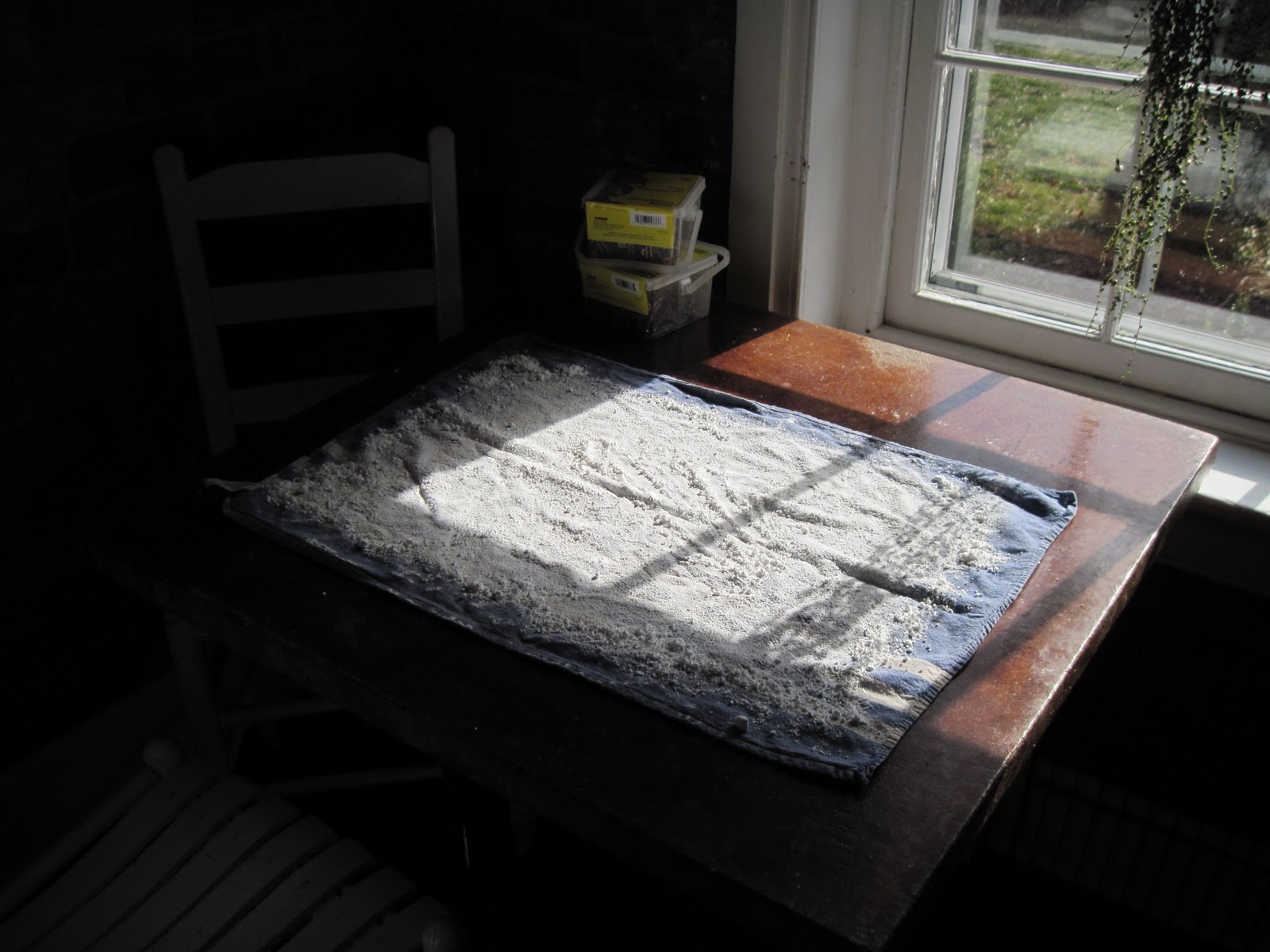
While the large flat rectangle baked in our upper oven (20 minutes on the nose, you were right, sis), I dropped powdered sugar onto a dish towel, see above.  I let the cake cool while I ate a carrot (she suggested "a few minutes"), then flipped it (cake, not carrot, smarty) upside down onto the towel.
Right away I rolled it up -- "like a jelly roll" she said.  I never much cared for jelly rolls and have never made one.  I think I figured it out.
Unroll, she said.  Monkey say, monkey do.
Now for the funnest step of all.  Yes, I'd remembered to let the ice cream soften up a tad, just as she prescribed, even though I doubted that I should get it out of the freezer while the cake was still baking.

"I was watching as you rolled up the ice cream," says Virginia.  "I couldn't believe you washed your hands after every time you licked your fingers. Congratulations!"
Piece of cake.  All you have to do is follow the fine recipe. Oh, don't forget to put it in the freezer.

Sunday, January 23, 2011

Old Milwaukee, the Cadillac of Furnaces

Every now and then we need to clean the catalytic converter on our wood stove. This requires a complete shutdown and cooldown and means for a couple days we get to rely exclusively on our antique Old Milwaukee oilburner. According to one repairman, it was the Cadillac of furnaces 50 or 60 years ago, "we can still get parts," and it'll chug along forever with consistent maintenance. He even said he'd keep it instead of buying a new, much more efficient furnace. Ironically, I agree except in the summertime, when it'd be nice to have central cooling. Because we use it as a backup and supplementary to our wood stove, it may not make a whole lot of sense to replace it.

When we bought this house, we paid $1,000 or so to fill the 500-gallon tank and it lasted 18 months. We refilled it half way a couple weeks ago, figuring we don't want much oil sitting around if we decide to get a HVAC unit this year. You can do the math. How long would it take to make a new furnace pay for itself? Very long, unless oil prices went sky high.

"How can we figure?" says Virginia. "You didn't say how much a new furnace costs."

Well, if you figure we spent $500 per winter the past 3 winters, that suggests a very long payoff period. The $4,000 furnace we put in our little cottage lasted 8 years, the same period someone else mentioned from their recent experience. $500 per year times 8 takes us to $4,000, but that doesn't include whatever fuel runs it. Yes, a furnace should last longer than that, but how much longer? Not as long as the Old Milwaukee, bet your booty.

So here we are with a classic choice. Would buying a new furnace be better for the environment? Hmmm. A few years ago I posed a similar question to someone promoting hybrid cars. Should we hold onto our 15-year old Volvo that continues to be very dependable or should we exchange it for a new vehicle? It would save fuel going forward, but what about the cost of producing the new car and the cost of junking the old one? His answer was, keep the old one and buy an efficient new one when it conks out.

"You're comparing apples and oranges," says Virginia.

She's right. A new furnace would offer several advantages: (1) more efficient use of the energy source; (2) as we age we may prefer not having to hunt for firewood, so our $500 per year cost could go through the roof (see, we have costs beyond $500 -- gas for the chain saw, blood, sweat and tears); and (3) a new unit could also cool this hot house in the summertime. Besides, we might be able to find a unit with very low operational costs, such as a geothermal or solar option. And the longer we wait, the more options might present themselves.

I'm not interested enough to do gobs of research at the moment. Maybe you can help me with suggestions.

Saturday, January 22, 2011

Thrills of a Geek Week

I kind of like the shorter workweek someone proposed to create jobs for more people. Would that mean I need to hire someone to help reduce the workload around here? Karen's the only one who knows how many hours I put in. Many acquaintances think I'm retired. Perhaps they don't know you can wander around listless quite a bit if you throw in a few hours after dinner.

This week I neglected the homestead, focusing on two things -- the Arrowhead Trio concert Wednesday night and a major book update -- although I did visit the greenhouse first thing every morning and ran at least 4 miles each day (usually around our field, accompanied by Lex and Rosie, who dashed circles when they thought I was heading out the door). I tumbled down the stairs, fixed my apple cider vinegar tea (with the "mother"), and wandered out to see how the 10 varieties of lettuce were doing. Two more breeds haven't sprouted yet. Each day I microwaved oatmeal, squeezed an orange and grapefruit and filled the rest of the glass with grape juice, read my breakfast, then headed back upstairs to research and write about the Real Estate Settlement Procedures Act. Or maybe I went to Arrowhead Lodge to practice piano for a couple hours first, not that it did much good for Hans Gal. Poor fellow, I'd bet he turned over in his grave, especially on the night of the concert.

I tried to prepare the audience for his trio, calling him a twentieth century Bach who wove melodies back and forth among the instruments. One of our responsibilities as musicians is always to know who in our group is "on first" and to convey that to the audience, sort of like a game of musical chairs, lacrosse or soccer. I warned them that, if they were like me watching hockey, they might have trouble keeping their eyes on the puck. Maybe it's my fault I saw quite a few heads nodding. I think it's safe to say we've put that trio to bed.

Likewise, tonight I sent the book update to my co-author for his review. He'll probably invest his free time tomorrow (Sunday) looking for the jokes I've hidden among its 70 pages.

"I bet they're hilarious," says Virginia.

Definitely hard to find, definitely.

Oh, a couple days ago I set about building a couple coldframes, but we're out of screws even though quite a few are loose around here.

Wednesday, January 19, 2011

The Importance of Context

If you're looking for a job, perhaps the courts could use you. About 15 years ago, my friend, David Stemler, and I wrote a book on the Real Estate Settlement Procedures Act (RESPA). That's the law that requires the "Good Faith Estimate" (GFE) of settlement costs you receive when you apply for a home loan, and the settlement statement (HUD-1 or HUD-1A) when the loan closes. Since the book was published, we've updated it 2 or 3 times per year. Back in the early years, it often was hard to find court decisions that dealt with RESPA -- 50 per year was a hefty number. That's no longer the case. I found nearly 500 cases decided between July 1, 2010 and January 2011.

RESPA imposes many other requirements. For example, it prohibits providers of the services involved in obtaining your loan (appraisals, brokers, lenders, real estate agents, pest inspectors, etc.) from paying money to each other unless services are actually rendered. For example, lenders can get into trouble if they give tickets for sporting events to real estate agents who refer loans. I've sometimes wondered if Congress ought to pass a similar law for health care -- for example, restrictions on drug companies flying physicians to Hawaii for classes on a newly approved pill.

RESPA also requires your mortgage loan servicer to respond in a timely manner to your "Qualified Written Request" for information about how it has applied your loan payments and any other questions relating to the servicing of your loan. To be a "Qualified Written Request," you must include specific information in your request (such as enough information to identify you, your loan and the information you want) and send it to the right address.

Consider this: You get a mortgage loan from a local bank, which chooses to service the loan instead of selling the servicing rights to some other company. A year and a half later, you notice your payments haven't been properly credited to your account, so you send a letter about this. RESPA requires your bank to answer you fairly quickly.

Now consider this: You get a mortgage loan from a local bank, which chooses to sell the servicing rights to another company. A year and a half later, you notice the same problem as in the previous paragraph -- your payments haven't been properly credited -- so you send the company a letter. According to a recent court decision -- wrong, I dare say, -- RESPA would allow that company to ignore your letter.

How did the judge come to this conclusion? He turned to a poorly drafted sentence in Regulation X, which implements RESPA: "[A] written request does not constitute a qualified written request if it is delivered to a servicer more than 1 year after either the date of transfer of servicing or the date that the mortgage servicing loan amount was paid in full, whichever date is applicable." Because the servicing company received your letter more than 1 year after the servicing rights were transferred to it, your letter wasn't a "Qualified Written Request" and, as a result, the servicer didn't have to respond.

"Well, I guess that makes sense," says Virginia, "after reading the sentence the court quotes, but the result doesn't make sense to me, the borrower."

It doesn't to me, either, and my money's on other courts disagreeing with this judge. I'm quite sure HUD intended the sentence to have a limited meaning -- referring only to a servicer that receives a letter after servicing has been transferred to another servicer. Otherwise, the response requirement would disappear for up to 29 years of a typical 30-year mortgage. (And Lenders that want to retain servicing might even transfer servicing for a few months and then get it back, in an attempt to escape the response requirement.)

A look at the RESPA statute suggests the judge is wrong. The statute clearly applies to the letter received more than a year after the servicing transfer. On the other hand, the statute gives HUD the authority to adopt regulations and exemptions, so one could argue that the quoted sentence amounts to an exemption. I imagine HUD, or the new Consumer Financial Protection Bureau, will clear this up before long.

By the way, if you want to send a letter to your lender or servicer, HUD offers a sample letter and guidance at www.hud.gov/offices/hsg/ramh/res/reslettr.cfm.

Sunday, January 16, 2011

Suspension of Disbelief

"Billy Elliot" (see previous blog post) did not disappoint. A show as good as this encourages the audience to practice something, write, compose, choreograph or whatever else one might wish to pursue or perfect. It also brings to life the "suspension of disbelief." For three hours, we're asked to believe -- that in a town where everyone sings and dances, its striking coal miners have no other talents for making money if the mine closes, and two of them think their son and brother should not waste time on ballet. I'm mostly kidding; no, we're asked to believe, for a few hours, in the fiction presented by actors for our enjoyment. We know we've entered suspension when a man sitting behind us sobs into his handkerchief and our own cheeks are damp.

Then the curtain falls, the house lights turn on, and we're reluctant to return to disbelief. Our toes try to point uncomfortably. Our mouths attempt to form British accents. Teachers from long ago float in the peripheries of minds. For moments, we regret canceling lessons and maybe we think about writing a check to a local arts organization.

By the next day, life has almost returned to normal.

"Pure silliness," says Virginia.

No, it wasn't silly at all. Maybe a thousand people joined to applaud a cast of talent, to invest an afternoon in something other than routine.

"I mean," says Virginia. "It's silly to leave it all behind. Dream a little, will you?"

Thursday, January 13, 2011

Arrowhead Trio January Concert -- Gal, Moszkowski, Schickele

I'm looking forward to seeing the musical "Billy Elliot" this weekend. Karen's dusted off her ballet shoes and I've been limbering up, in case we go somewhere after. I imagine what will impress me most is the kid's ability to sing and dance at the same time. I've seen how out of breath the contestants are on "So You Think You Can Dance?"

Lately I've been thankful I'm more of a pianist than a singer. It can be tough keeping a voice in shape through the throes of winter and seasonal allergies. Often when I'm sick I still can play piano, at least until the sneezed-on keys get sticky.

"Get to the point," says Virginia, "you're building up to something."

She's beginning to sound like a broken record. Check out yesterday's blog entry if you don't know what I mean. All right, I was just thinking how self-centered blog entries and Facebook status entries can be, especially when artists post their own accolades. Then I reconsidered, it's a tough world out there, if they don't promote themselves, their friends might not even know.

Here goes. Any nearby readers, if you've got next Wednesday night free -- we realized too late we're competing with Andrew Young speaking at Washington & Lee U -- you might check out Kendal Hall, Kendal at Lexington, for The Arrowhead Trio's next concert, see below.

The Arrowhead Trio will offer selections of twentieth century music at Kendal Hall, Kendal at Lexington, 160 Kendal Drive, 7:15 p.m., Wednesday, January 19, 2011. The group will play Hans Gal’s “Trio,” Maurice Moszkowski’s “Suite in G minor,” and Peter Schickele’s “Serenade for Three.” The members of the trio are Winston Davis, violin, John McClenon, clarinet, and James Pannabecker, piano.

Hans Gal, born in 1890 near Vienna, was appointed Director of the Mainz Conservatory in 1929 but was dismissed in 1933 when Hitler came to power. His work was banned from publication or performance in Germany. He eventually became a lecturer for the Department of Music at the University of Edinburgh, Scotland and a British citizen. His clarinet trio is polyphonically complex, with moments of lyrical beauty.

By 1908, Moszkowski reportedly was a hermit of sorts, refusing to teach composition because "they wanted to write like artistic madmen such as Scriabin, Schoenberg, Debussy, Satie…” and perhaps Hans Gal. The Suite the Arrowhead Trio will perform was scored for two violins and a piano. The second violin part has been transcribed for Mr. McClenon’s clarinet. Perhaps the following story is true. Hans von Bulow filed this entry in an autograph book, “The three greatest composers are Bach, Beethoven and Brahms. All the rest are cretins.” When Moszkowski saw it, he inscribed underneath, “The three greatest composers are Mendelssohn, Meyerbeer and Moszkowski. All the others are Christians!”

The third composer, Peter Schickele, born in 1935, may be better known for his association with P.D.Q Bach, the “last and by far the least” offspring of J.S. Bach who has been called a “pimple on the face of music” and “the worst musician ever to have trod organ pedals.” Schickele’s “Serenade for Three” includes variations on a theme from P.D.Q. Bach’s “Oedipus Tex” and a rousing barn dance. A recent coup was Shickele’s creation of the musical score for the film version of Maurice Sendak’s “Where the Wild Things Are.”

Wednesday, January 12, 2011

Judge Me Not

I've been self-employed for 17 years, except for one 18-month diversion prefaced by a wiser brother's "why would you want to do that?"  Januarys tend to welcome me to each new year with a reminder of the benefits, as if I need one, such as -- when the inevitable snow falls or ice gathers, I can admire it through a window or retrieve my cross-country skis from the barn.  In fact, it's a perfectly good excuse to stay inside and get some work done, work I then won't have to do on balmy Spring-like days.

This January has been no exception.  As a result, I've immersed myself in court decisions.  Today I read one that worried me a bit because it contradicted something I've written.  I almost left it dangling, certain to pester me in the middle of the night when a train waked me and sent me to the bathroom.  One of the advantages of advancing age is a tendency not to procrastinate about things like this.

According to the judge, a provision of the financial reform bill (Dodd-Frank Act) relating to the Truth-in-Lending Act did not take effect until January 1, 2011, the first day of "the taxable year" following enactment of Dodd-Frank.  I didn't remember this.  In fact, I remembered using too many words to explain what I thought were possible effective dates, none of which was January 1, 2011.

So I pulled up the Act and searched for the words quoted by the judge as calling for January 1, 2011.  They appeared once in the Act, at its very end, after the last section:  "(b) EFFECTIVE DATE.—The amendments made by this section shall apply to taxable years beginning after the date of the enactment of this Act."

"You're boring your readers," says Virginia.  "Cut to the chase."

All right.  The section referred to has nothing to do with the topic the judge was addressing.  The effective date for that topic lies elsewhere.

"Assuming your search function worked," says Virginia.

Yes, good point, but I'm not going to spend half of tomorrow reading the bill word by word, something I've already done several times.

Monday, January 10, 2011

Manure-Heated Greenhouse

Our outside thermometer read 22 degrees early this morning, while the greenhouse temperature was 30 degrees.  The big compost bin may be working!  It steams slightly, more when I turn it with a shovel.  Now, at 10:30, under cloudy skies, the gray sky has warmed the outside temp to 28 and the greenhouse to 45.

"So what's next?" says Virginia.

Several things come to mind:

1.  I may insert black plastic drainpipes with the hope that they'll bring more of the heat directly into the air.  As it stands now, the outer layers might be serving as insulation, keeping the heat in.  Any chemists out there with suggestions?

2.  I'll place some wooden slats across the top of the compost bin, and on top of them put seed-starting flats.  I resisted the urge to order a few heating pads to place under seed flats, because I want to keep this project free of traditional energy usage. The compost bin may serve the same function as the heaters.

3.  I should completely fill the bin.  I suspect the more mass, the more effective it will be.

4.  I may add another bin or bins to the greenhouse.

5.  Several commenters on other blogs expressed concern about the compost burning the place down.  A couple years ago wood chip mulch started a fire in nearby Lexington.  I doubt this will be an issue with the moist manure mix I'm using, so long as I keep the straw and other carbon elements well distributed, but I'm keeping an eye on the possibility.  Perhaps I should find a thermometer with a probe that measures the highest heat in the pile.
"What's that white stuff?" says Virginia.  "Looks like tinder to me."

She's right.  I emptied our paper shredder this morning and failed to turn it in well.

6.  For next winter, I want to consider a solar heater of some sort, with solar panels.

7.  It's about time to get seeds started -- for broccoli, cabbage, cauliflower, and other early spring feeders.

8.  Eight varieties of lettuce, two types of broccoli, and some cabbage have sprouted in the two raised beds.  They're growing very slowly in the cool temps.  I wish I'd planted them earlier, but there was no greenhouse earlier.
You may need to click on the photo to see a couple rows of tiny lettuces.
Above you'll see some broccoli.

If anyone has experience with manure-heating, please don't hesitate to comment.  If you have trouble getting Blogspot to accept the comment, try the anonymous option.

Sunday, January 9, 2011

Screaming

America, let's make a deal and turn off the screamers -- whether democrat, republican, libertarian or whatever.  Simply switch to another station or find something else to do.  If all of us stop listening, maybe they'll shut up.  They're bound to when the money stops rolling in.

"That's easy for you to say," says Virginia.  "How much time do you spend watching TV or listening to radio?"

Hey, I was screaming the other day.  When I realized no one was listening, I felt like an idiot.  The mirror cracked.

I smell turkey soup.  Karen cooked one of our frozen flock yesterday.  The bones went into a stockpot.  Soup's especially welcome in cold weather.  Tonight's low may reach the teens.

"You're avoiding me," says Virginia.

Maybe it's time to toss her into the soup, maybe one of those self-help books ("Virginia's Soup for Civil America")?  I've heard they usually sell better than novels.

Saturday, January 8, 2011

Thank You

As we left to take our son to the airport this morning, I said I would need to focus on firewood this coming week.  What do you know? Manna from heaven had arrived with dew in the night!  At the corner of our property, which poor drivers tend to visit from time to time, firewood littered the roadside.  "I wonder if it'll be there when we get back," I said.

We forgot the gift until we returned and saw it waiting.  For whom?  Certainly the previous owner had noticed it sliding off his truck or bouncing out of sight.  Why didn't he stop to retrieve it?  Maybe his radio had been blaring and he didn't sense a thing.  Maybe he wrecked at the corner and abandoned his load (not likely, it wasn't a full load).  Maybe he stole it and when it slid off he was afraid a pursuer would catch him reloading.  Maybe he realized his truck was overtaxed, so he purposely lightened his load.

Enough hours had passed, so I decided to assume the firewood was abandoned, for whatever reason, that it was waiting for me or someone else, most likely me, because it rested on my land.  Still, as I threw it over the fence, I felt a tad guilty that some poor soul had met misfortune and I was abusing his trust by not saving it for him.

"Maybe he was the guy who drove through the fence a few years ago and left a pickup in the field," says Virginia, "and he was repaying you for the damage."

Exactly.  Or maybe someone else was leaving me an anonymous late Christmas present, and wouldn't he feel bad if I wrenched my back moving the firewood to our woodshed?  Maybe he'd been sawing up one of our trees and quickly departed when our lights turned on.  No, that would have been a bunch of trees -- a sycamore, a couple oaks.

"Right," says Virginia, "or maybe he'll be pounding your door tonight asking what happened to his stuff."

Exactly.  That's why I put it back where I found it.  Someone else can hassle the consequences.  (Did I really?)

Friday, January 7, 2011

Nosey Neighbors

"Your greenhouse sure is empty," says Virginia.  "Why don't you fill it with pots and get started?  Stick a heater in if a night's going to be too cold?"

I don't want to use a heater, which might not only be expensive but might burn the place down.

"What's the point, then, for having it?" she says.  "You could set up a hydroponic garden and grow tilapia or perch in the water."

Patience, patience.  Some day that may happen.  Remember, the greenhouse arrived at the end of Fall.  I didn't have a chance to get things going this season.

"Oh, come on," she says. "You've managed to finish a bunch of book updates, run hundreds of miles, practice piano for a couple concerts, and write a few poems.  Certainly you could have devoted some time to the greenhouse."

Yeah, well, get off my back.  You're probably feeling neglected yourself, like the woman who says our donkey's too thin.  Go ahead, sick the greenhouse protection society on me.

(Some people need to listen instead of talk so much.)

Monday, January 3, 2011

Dispensing Our Collection

In 1994, after buying a Victorian home in North Carolina, we sold most of our things at a yard sale in St. Louis and moved, planning to buy what we "needed" to outfit the new old house.  We had enough left to fill a 16-foot U-Haul truck. Four years later, we replaced the Victorian with a bigger "country club" home and bought some things to make it look lived in.

Four years later, we had another yard sale and moved to Arrowhead Lodge and the little cottage next door, in Virginia. Allied Van Lines filled a 52-foot semi-trailer, but didn't anticipate the hill in our lane.  "Are you working today?" the driver asked.  "No."  "Could you drive your pickup up and down the lane as we gradually empty this truck?"  "Sure, Karen and I can do that."  So went the day, the scariest moments involving the transfer of my 9-foot concert grand onto our 7-foot pickup bed, with Karen driving while the two movers and I held on tight -- so much for my original plan to disappear for the piano moving.

Four years later we moved into this farmhouse, again using our pickup to transfer what we needed, but with no semi -- and the concert grand stayed.

Four years later, we aren't moving.  I don't think.  If we did, we'd probably need two 52-foot moving vans unless we had a giant yard sale or auction.  I wasn't planning to get rid of anything until today, when I read my sister's blog posting (http://steinermp.wordpress.com/) and discovered that my best friend has suggested doing it.  So I began taking inventory and discovered the job is bigger than the inventories we took when I worked for the Great Atlantic & Pacific Tea Co. (A&P).  Actually, an inventory probably isn't necessary.  We could simply start taking pictures and posting them on Ebay, not a bad idea.  Think how much easier picture-taking is these days, and so much cheaper, not having to buy film and pay for processing.

"Come now, you've got to be kidding!" says Virginia.  "You're just getting started on the greenhouse, and the goatherd has settled in nicely."

Hmmm.  It might make sense to get a head start on 2012.  Six years in one home is a long time.

Sunday, January 2, 2011

Fire Hazard

Karen reported a warm 50 degrees (F) this morning. That, combined with her cleaning out the barns to add to the greenhouse compost bin, and a dwindling pile of properly sized firewood, pulled me outside.  I snapped on my Christmas coveralls, sharpened the chain saw, and set to work.  Suddenly it felt as though I was standing naked in cool air. "What is that cold stuff running down my leg?"  Colder than water, boom, my brain figured it out and shut off the saw.  If it had waited much longer this blog entry or any others might never have been conceived.  I changed into different clothes and tried again.

I don't know what got into me, burning through 4 tanks before stopping.  (Actually, 5, but we can't count the first one.)  Usually I'm spent after two.  The five truckloads of logs Adam and I collected a couple months ago have been reduced to 5 or 6 thick challenges.  After they're conquered, it'll be time to rent a logsplitter to finish off a big pile in the corner of the woodshed.

"Wuss," says Virginia. "Didn't I see a new awl leaning against the woodshed wall?"

Yes, pretty new, but I'm not a wuss -- I'm a realist.  As Hellgate demonstrated, this fellow has trouble staying upright.  Put an awl in his hands and, well, even Virginia better not come close.

Saturday, January 1, 2011

Happy New Year!

Welcome, please come in,
your table waits over there
or there, you must find it

now is your chance
to re-arrange the deck
you've been dealt

one-by-one,
seven-by-seven,
fifty-two by fifty-two.

-- dictated this morning by Virginia