Monday, July 25, 2011

Global Rupture?

The pigs are doing a good job roto-tilling a garden bed, their test site.  We're getting a little sweet corn from the field garden, which will be their next project.  Some winter squash seems to be doing all right in that garden, too.  If we put the pigs out there, will they stay inside their electric fence?  We plan to gradually move them around the big garden.  A fence break could badly mess things up.  Hitting a deer is no fun.  Hitting a pig wouldn't be, either.

If the field garden experiment works, then we may move the pigs or their replacements around the field.  Bit by bit we might be able to plant the field with native grasses and animal food, such as oats and barley.  Or blueberries, pumpkins, strawberries, etc.  I don't know about monoculture planting though, a quarter acre or twenty-five.  How big does it have to be before it becomes monoculture?

Reading Silent Spring, including Rachel Carson's account of the use of DDT on elm trees in Michigan and elsewhere, leads me to wonder if, 60 years later, the robins have returned.  Have we learned from that experience or are we doing the same sort of thing with "safe" treatments like Roundup?  There's so much we don't know.  We should be wary of introducing any inventions into our planet's ecosystems.  I'm inclined to apply the grandmother test -- if grandmother wouldn't recognize it, don't eat it, and think ten thousand times before spraying it on plants. 

"Hey, what's it matter?" says Virginia.  "The rapture is coming soon."

She's a kidder.  Too bad many other people aren't.

Sunday, July 24, 2011

Mirrors and Tombstones

Imagine looking in the mirror every morning (for a week or two) and seeing this:
You might hear, "Dahling, quit dilly-dallying."

Or this might be cool, sort of Fonzarellian (think Arthur Herbert Fonzarelli, "the Fonz" on Happy Days):
Here are some pretty bugs -- pretty darn nasty.  Our chickens have been getting most of them this year.  If you don't have chickens, I understand spraying them with a mixture of warm water, vinegar and some dishwashing liquid will send them to la-la land.  They suck, trying to destroy all the brassicas before moving on to other crops.  These two Harlequins are enjoying Brussels sprouts.  Aren't they beautiful? 
Here are some German Cushaw squash I trained to hang on the fence.
"Are you sure?" says Virginia.

Well, the seeds came from a Southern Exposure Seed Exchange packet labeled "green-striped cushaw."  A Google search of cushaw brings up several pictures of what I thought were Georgia candy roasters, which happen to be growing to the left of these guys.  Here's one:
Whatever, these are giant winter squash.  Cut one open and it feeds two people for two weeks.

If you read my blog entry from yesterday, about cleaning up the greenhouse, here you can see what I've been doing -- pulling weeds, then covering with a layer of black plastic under a layer of black mesh cloth, and in the aisles, a rubber mat.  The wooden 2 x 6's will form the back sides of two more beds -- I'll be cutting and removing the plastic to the rubber runner -- in which I'll plant, who knows, maybe lettuce, broccoli, artichokes?  In each corner, I covered the black mesh with mulch and then four 2 x 6s that hold a broken marble tombstone that's intended to keep the greenhouse from blowing away in a storm.  No grave robbing;  a friend of ours who digs graves brought us four rejected broken tombstones.

Saturday, July 23, 2011

Greenhouse Reconstruction

A rush job almost always has to be redone, doesn't it? 

On our 22nd anniversary last October, having received an email that a local business was shifting gears and selling their greenhouse, we checked it out and bit.  Two weeks later its pieces were in a pile near our older and littler greenhouse.  Then in a few more weeks it was up and ready to go, except I hadn't given much thought or attention to the floor.  That was fine until this summer, when the place entered the first stages of becoming a forest. 

This week, after meeting pressing deadlines, I attacked the weed patch, put down black plastic covered by black mesh cloth and, in the two aisles, laid long rubber mats, all despite 110+ degrees even with big fans blowing.  I was not about to plant fall garden things and winter greens while having to push aside wiregrass growing like cobwebs.  I also began to close gaps in an attempt to get the place ready for cold weather.  I'm not finished yet, but it's looking civilized again.

"Fans blowing?" says Virginia.  "In your greenhouse?"

Umm, haven't I mentioned that for our birthdays this year, we had electricity installed in the barn and the greenhouse?  Now my plants can listen to classical music.

Friday, July 22, 2011

Gotta Live in the Present

My cellphone's on the blink.  It didn't work for a couple days.  I could send out, but couldn't hear anything coming in. 

"Not so unusual," says Virginia, "for you."

She's right, as usual.

Wednesday, July 20, 2011

Happy Birthday, Dodd-Frank!

Most of us have awakened in the middle of the night and fretted.  Something about the peace and quiet of a dark space often invites focus on something, anything, that suddenly takes on incredible importance.  Next time this happens I think I'll turn on a light, in the hope that seeing other things will turn my thoughts to more realistic matters.

I used to wish that aging would turn me into the kind of wise man people liked to visit.  Phooey.  What a self-centered thought, like the patient who wants everyone to know what he's going through!  I have a feeling wise men have other things to do than hope people want to visit them to learn their secrets.

"Where are you heading with this?" says Virginia.

All right.  You probably don't care one bit that tomorrow, July 21, 2011, is the first anniversary of the enactment of the Dodd-Frank Wall Street Reform and Consumer Protection Act, a/k/a the financial reform bill or the banking bill.  I, on the other hand, who has been immersed in it day in, day out for the entire year, see the day almost as light at the end of a tunnel, albeit a temporary end.

But yes, I get it.  It means nothing to most people.  It's time to pull weeds in the greenhouse.

Sunday, July 17, 2011

Arrowhead

Today, I dug holes for a couple peach trees.

"You should plant trees in the spring or fall," says Virginia.

Yes, maybe.  Anyway, I lifted a shovel of dirt and dropped it onto the pile I would later return to the hole, and a tiny stone caught my eye.
Front
 Back

"How do you know which was front and back?" asks Virginia.

Picky, picky.  What do you think happened a few thousand years ago when this arrowhead dropped to the ground?  Squirrel, rabbit, bird?  Maybe not.  I understand even projectile points of less than an inch could drop a deer (http://archaeology.about.com/cs/lithics/a/thepoint.htm).

The stone may be worth 87 cents.  The experience is not.

Saturday, July 9, 2011

Feeling A Draft (Draught, Dray)

When we lived in our cottage and cabin 4 miles up the road, the relatively unusual sound of a car would announce that someone was coming several minutes before they arrived.  We had time to prepare.  Now, comparatively, we live in a city.  Everyone coming into or going out of the valley drives past our house, and you can't get to Yogi Bear's Jellystone Park without sending at least a little road noise our way.

Maybe we keep getting more animals because we hope they'll drown out the engines.  They're pretty effective at slowing down traffic, as people gawk, "Hey, look at the cute goats.  What is that, a mule?"  Many people think a donkey's a mule.  More and more often, it seems, strangers drive down our lane, as if it's a petting zoo.

When I read this ad in the local paper, I had to call: ""Farming with Horses -- I am seeking a working farm and farm family in Rockbridge County who could be interested in, would enjoy, and whose farm would have work for and might benefit from a pair of light draft horses and horse drawn equipment, wagons, harnesses, tack etc. ready to go to work farming, logging, giving wagon rides and being ridden.  Along with the horses and the needed equipment would come their owner several days a week, ready and wanting to go to work and pitch in to the best of his ability.  I'm on the lookout for a working farm family that will be real particular about any addition of livestock or people to their farm, just as I'll be in finding the right farm and family.  I will greatly appreciate hearing from anyone having possible interest, thoughts or leads regarding this quest."

I can picture traffic slowing way down if a man and a horse were working our field.  It might be necessary to open the gate so folks could park and watch, rather than frighten the horse with screeches, screams, sirens and ambulances.  Maybe in 5 or 10 years, I'll be ready to try a draft horse.

"It'd be so cool," says Virginia.

Hmmm, maybe not on a summer's day like today.

Tuesday, July 5, 2011

Garden Grocery

Olga doesn't feel lonely for long this time of year because she has frequent visitors.
Eleven young chickens peck around all day, attacking insect pests and occasionally, young seedlings, which I try to overlook because I think generally they're doing a good job, especially on the Mexican bean beetles.  We're fattening a few rabbits, too, the worst of the pests.  A few humans show up quite often, because the garden's in full production now and if all goes well, will supply our table with fresh groceries until October or November.

Of course, she has cohabitants, from towering sunflowers to prone garlics.  The garlic has been gradually saying goodbye.

The sunflowers want to stay around a while.  Their seed pattern reminds me of running with John Zerger, a mathematician, who in turn reminded me of Fibonacci from a college mathematics class, maybe group theory.
You might notice two series of curves, one winding one way, the other winding the other way.  As I recall, the number of spirals going each way is different -- typically 34 and 55, 55 and 89, or 89 and 144 -- part of the Fibonacci sequence -- 1, 2, 3, 5, 8, 13, 21, 34, 55, 89, 144.... (notice that each number is the sum of the two preceding numbers).

"Whoopee!" says Virginia, "and why is that?"

I understand it's the most efficient way of filling the space, but we'll leave the proof of that to someone else some other day.

My sister might be envious of this row of vegetables.
Kohlrabi

This year, for fun, I planted some spaghetti squash.
 "I guess you planted this next guy for the squirrels?" says Virginia. 
Yes, for the giant squirrels that live in the manor, this vies with butternut as their favorite squash.

Sunday, July 3, 2011

Threshing

The biggest challenge of growing your own wheat is harvesting it.  So, knowing 30 young people would be camping in our field a few days before setting out on a "teen adventure," we invited them to help out.  To get ready, Karen and I cut off the tops of our wheat plants and stored them in giant plastic bags.
Trimmed wheat; already being converted to a sweet corn garden.

When the young people arrived, we laid out plastic and set them "a flat-footin.'"
Stomping on the right; separating the wheat on the left.

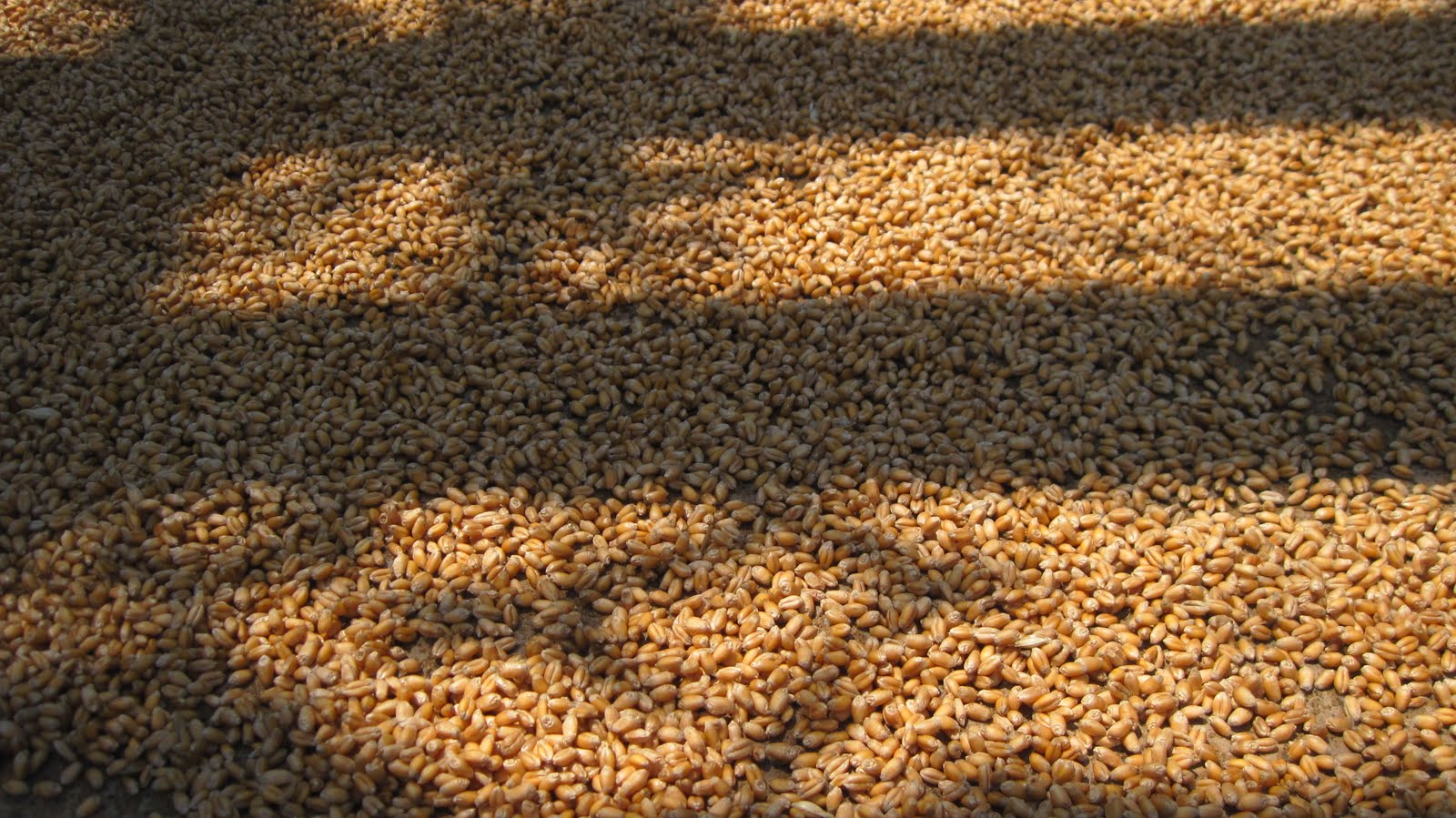
The separated wheat went into a bin, where it was washed several times.  The chaff and straw floated to the top, while the grains of wheat (wheat berries) sank to the bottom.  Then we spread the grains out to dry.
Sun drying wheat berries.
Ditto.

Soon we'll be able to grind it in the NutriMill and turn the flour into bread (or pizza dough).
"Wouldn't that have taken days by yourselves?" says Virginia.

Exactly.  With all this help and conversation, it was fun for all of us.

Friday, July 1, 2011

One-Third, not One-Twelfth

Someone stuck a summons on our front door a couple weeks ago, for me, to join a panel of peers at the courthouse.  Karen's been wondering why I haven't blogged about this, since I returned to Elk Cliff at 7:30 Wednesday evening.  She could tell right away my day hadn't been pleasant.

The prosecutor had finished his rebuttal about 3:30 and a couple hours later I was afraid the others, anxious to go home, one of them to work, would be throwing darts at me at midnight.  By the time I left the parking garage at seven, I was very grateful for the three jurors who had come to the same conclusion as I.  Hopelessly deadlocked, the judge called us "hung" and declared a mistrial.

Two days later, I'm confident four of us arrived at the "right" answer, although I'm sure some of the others think we wasted their and the government's time.  In fact, near the end, the foreman gave a little speech about how a hung jury would disappoint him, that it would mean our system of justice had failed.  I couldn't let that one go and added my own speech that, no, the system had worked just fine.  If the prosecution wanted to try again, and perhaps do a better job, it could do so and might learn from it, or it might decide the matter wasn't worth another twenty or more person-days of effort and learn from that.  Another fellow pointed out that one reason we require a unanimous verdict is to help prevent like-minded people from railroading a conviction or acquittal.

"Hmm," says Virginia. "I bet you voted not guilty."

Now why would she think that?  Was it something I said, the tilt of my head, a glint in my eyes?  Let me just say, one of the attorneys might regret not kicking me off the jury.  I would have bet I'd be one of the first disqualified.  If there's a next time, I'll probably disqualify myself if given the chance (as we were this time).

Words.  Recently I observed that the Federal Reserve Board writes regulations that contain more than 10 times as many words as the underlying statute.  If that's really necessary, it might seem peculiar that criminal statutes, and jury instructions, tend to be quite short, leaving lots of gray area -- especially when you consider the drastic penalties they entail.  Please don't blame other members of your jury who read the same words differently.

Thursday, June 30, 2011

Silent Spring

My online bookclub associate and I have begun reading Silent Spring by Rachel Carson as our "classic" for June.  Many credit this book for kicking off the "enviromental movement."  My father, a biologist, read it back in 1962 when it came out and promptly began using it in his university classes and occasionally at our dinner table.

I'm still near the beginning of this book, but I'm astounded how "current" some of it remains.  I read recently that the purple boxes hanging from trees in Virginia are part of an effort to study the movement of emerald ash borers from North to South.  When I heard a couple years ago that my hometown of Bluffton, Ohio has lost most, if not all, of its mature ash trees, I thought, does this mean the ash trees on our farm will soon follow suit?

Here's what Rachel Carson wrote about elm trees.  I imagine we could insert "ash" each time "elm" appears and it would remain fairly accurate:

"The same thing happens in other situations.  A generation or more ago, the towns of large areas of the United States lined their streets with the noble elm tree.  Now the beauty they hopefully created is threatened with complete destruction as disease sweeps through the elms, carried by a beetle that would have only limited chance to build up large populations and to spread from tree to tree if the elms were only occasional trees in a richly diversified planting."

I remember thinking back when elm trees were being destroyed that it was such a shame, that nature would do this to a variety of tree.  I didn't know then it was our fault -- concentrated planting.  Or that the same sort of thing happens when farmers plant thousands of acres of one crop -- and we find ourselves "needing" pesticides to control insects that descend on huge fields.  And then, as Carson wrote so long ago, the insects develop super-species immune to those pesticides, while the pesticide residues remain in soils, streams, water supplies, and eventually, human cells, mother's milk and embryos.

50 years later, the processes described in Silent Spring continue.  Most of us are oblivious.  History remains a class we suffer through and forget.

"Shame on us," says Virginia.

Monday, June 27, 2011

Backyard Grocery

The rooster that simmered for several hours in our oven this afternoon offered very little meat to three young men, Karen and me, which is fine for me, perhaps disappointing for them.  A plateful of vegetables is enough to make me smile.

Soon it may be time to post the "Fresh Vegetables" sign on Elk Cliff Farm. 

"Save money on paint," says Virginia, "'Vegetables' will do the trick.  Of course they're fresh."

  • Some tomatoes have turned red.  
  • I always miss a few cucumbers when I look for "future pickles of America."  
  • The garlic is about ready to be pulled out, dried and braided.  
  • We should eat potatoes every day so they don't sprout in the basement this Fall.
  • It's about time to surrender beets to winemaking.
  • The next planting of green beans is blossoming, so maybe two will overlap and swamp us.
  • Twelve varieties of lettuce are bitter and bolting, save one and the summer crop that's growing under an ash tree.
  • We need to get more olive oil to make pesto from parsley, basil, oregano, garlic and home-made cheese.
  • The broccolis are forming little heads again, while the cabbages have become downright arrogant (big-headed).
  • The straw of winter wheat waits to be pulled and replaced with corn, beans and other things.
  • We might have enough carrots for wine.
  • It may be time to dig a root cellar for onions and others.
"You forgot something," says Virginia.

I covered everything from "a" to -- oh, zucchini, in a few days we'll have some.  I noticed two dark blackberries today, grapes getting fat, and tasty nasturtiums shriveling.

Gotta keep planting the grocery store.

Saturday, June 25, 2011

June's Sweet Pickles

What do you do when you have lots of cucumbers?  Make pickles, of course.

My favorite pickle recipe is for June's Sweet Pickles, which originated from my mother, and is named after her.  As the joke goes, most things these days were named after my mother, 89 as of last weekend.  No, seriously, they were named after her (Wanda June) and the month of June, although I'd be willing to bet she never made them in June.

"So, what's the recipe?" says Virginia.

Slightly altered by me, here it is.

1. Gather 3 quarts of cukes, the smaller the better.  Wash them.
 
2.  Make a brine of 2 quarts water and a cup of pickling salt, and drop in the cukes. Let them soak overnight.
 
3.  On the next day, mix 4 cups of sugar, 4 cups of vinegar, 1 cup of water, 2 tablespoons of whole allspice (or pickling spices), 2 tablespoons salt, and 1 tablespoon of celery seed.  Stir these ingredients well in a kettle on the stove.  Add the cucumbers (not the brine) and bring to a rolling boil (one that can't be stirred down).
4.  The original recipe says "not long."  I'd say boil for 3-4 minutes.  Put the pickles in canning jars and add the hot sugar/vinegar solution so as to leave up to 1/2 inch of headroom.  Screw the lids on tight.  A 10-minute stay in a hot water bath canner is recommended to be sure they seal properly, but probably isn't necessary.

Friday, June 24, 2011

Hypocrisy

The bank reform bill that's received a lot of press the past year -- the Dodd-Frank Wall Street Reform and Consumer Protection Act -- is approaching its one year anniversary, July 21.  On that date, several provisions take effect, including Section 627, which allows banks to pay interest on business checking accounts.

"Sounds like a winner," says Virginia.  "It seems as though banks would be delighted.  A little deregulation for a change."

Uh-hum.  So why did the Independent Community Bankers of America (trade association for smaller, local banks) send a letter to Federal Reserve Board Chairman Bernanke urging the Fed not to implement the deregulation? Because it fears the big banks will get all the business and the little banks won't be able to compete on price (interest rate).  It fears the change will result in "bidding wars for business deposits among banks" and "expose banks to potential liquidity problems." It says money may move from money market funds, which already pay interest, to the megabanks, further increase the concentration of bank assets, and exacerbate the too-big-to-fail problem.  Welcome to a reprise of "Wall Street" meets "Main Street."

"Let me get this straight," says Virginia. "So the little banks are upset because the big banks may get the free cookie?"

Well, there ain't no such thing as a free cookie.  Someone has to pay.  There are two sides to this cookie -- the interest on deposit side, and the interest on loan side.  As the trade association argues, banks will have to pay more for their funds and businesses (as well as consumers) will have to pay more to borrow those funds.

"So is it right?" says Virginia.

Is it right?  That's a good question.  Is what right?  Is it right for retailers who have cash on hand not to earn interest on their deposits?  Is it right for Wal-Mart-sized banks to predatorily price little banks out of business?  And is it right for people pushing for deregulation to change direction depending on the issue?

Wednesday, June 22, 2011

A Fruitful Day

According to local lore, in the very early 1900s a large package of what looked like raspberry canes arrived at the post office.  No one claimed it and rather than letting it go to waste, the postmaster hiked around the county, planting canes hither, thither and yon.  Now, as July 4th approaches, wineberries ripen.  After the first husks pop open, we have a 2- or 3-week window to harvest them.  The wineberry is a non-native invasive, one person's flower and another's weed.  I claim it as a flower.

Today I awoke with a plan.  After rounding my garden to gather cucumbers and green beans, and after milking, I would hike up "our" mountain to see if "my" wineberry patches were close to ready.  Probably too early, I thought, but maybe I could guess how much longer, and besides, I didn't want to miss out.
Aha!  I lucked into the first picking of the season.  Any earlier would have been too early.
With more than a gallon in my backpack (in plastic containers), I headed straight to our basement kitchen, where we "put food by."  I heated 16 cups of berries, put them in a jelly bag, and hung the bag over a pot.  While the juice dripped, I stir-fried green beans and broccoli in olive oil and bagged them up for the freezer.
"May I taste the berry juice?" says Virginia.

Go ahead.
First, I made jelly strictly according to the recipe in a box of Sure-Jell, using 4 1/2 cups of juice.  Mix the pectin (Sure-Jell) with a quarter cup of the 3 cups of sugar and add it to the juice, then bring the juice to a rolling boil (the kind that can't be stirred down).  Add the rest of the sugar and bring to a rolling boil again.  Boil for 1 minute.  Pour into jars.

Then I had 7 3/4 cups left, too much for 1 batch, too little for 2.  Time to do what I usually do -- wing it, without store-bought pectin. 

Here's my standard recipe:  Measure juice into the pot (in this case 7 3/4 C.).  Bring to a rolling boil.  Add the same amount of sugar.  Bring to another rolling boil, then stick a thermometer in the juice and take it on up to 220 degrees F. (8 degrees F. above boiling).  When it hits 220, keep it there for 9 minutes.  Pour into jars and seal.

That's what I did, except for one thing.  Remembering the Sure-Jell instructions -- measure and follow these directions exactly -- I had a thought.  Another old package of the stuff waited in our cabinet.  Might as well experiment.  I tossed it into the juice, before the first boil.  I had picked a combination of very ripe red berries and some not so ripe, because, from what I've read, the not-so-ripe fellows have more natural pectin in them.  So I figured I didn't need to add any pectin.  But since I had some, I dropped in a little box, enough for less than half the recipe I was making.  Otherwise, I followed my standard recipe.

I figured if it failed, we'd at least have runny raspberry syrup, which tastes mighty fine on pancakes and waffles.  It turned out great, maybe not quite as stiff as the Sure-Jell batch, but that's okay, I prefer jelly that gives.
 First Boil
Second Boil
In the Can

See the white 1/2 cup measure?  It holds the froth I skimmed off before pouring the jelly into the jars, a special treat.  The white cup and the jar without a lid hold the extra jelly from each batch.  I can compare them for thickness and taste. 

"And where was your wife during this exercise?" says Macho Man.

"She was hunting around town for a new faucet to replace the one in our canning kitchen, which has a couple holes that spray its user and several leaky connections.  If she hadn't had to order one -- sometimes it's hard to find appropriate fixtures for a mid-18th century house -- she probably would have installed it while I 'put food by.'  Thank you, sir!"

Tuesday, June 21, 2011

Summer Soiree

Happy Summer!

Johnny Mac, former big band leader who played with Herbie Hancock, welcomed summer to Lynchburg (make that Madison Heights), Virginia, at a "Summer Soiree" held at Winridge Manor (http://www.winridgemanor.com/).  I went along for the munchies.
"Pretty hot, huh?" says Virginia.

Yes, even after a giant gray cloud descended and we moved under cover.  We alternated short classical numbers with jazz standards.

Would you believe this fellow crashed the party?
"What brand is he smoking?" asks Virginia, as if she cares.  Click on the photo to enlarge it and, if your eyes are better than mine, you might know the answer.

Wednesday, June 15, 2011

Flower Power

This year's gardenscape includes a variety of flowers.  Here's an edible one that often appeared on dishes at The Blue Heron, our local favorite vegetarian restaurant, now defunct.
Nasturtium

Here's another edible flower, known for its seeds.
Sunflowers (edible) and Larkspur (toxic)

Take a look at this week's version of next week's sunflower.
Of course, veggies have flowers, too.  I couldn't bring myself to eat the artichoke, so here's what happened.
And here's a bloomin' onion.
Carrots anyone?  Actually, at this stage, the root's nasty woody.
If we're lucky, the cilantro will re-seed itself and we'll be able to toss it in our August salads.
This acorn squash has grown like crazy in the past 10 days.
"How's the bread doing?" says Virginia.

Sometimes it's hard to keep her on topic.  No flowers, but the wheat is almost ready to harvest.  Our 2-month old chicks discovered this garden bed today, so we're going to have to get busy soon.
.

Sunday, June 12, 2011

Tired by Bedtime

A friend said she'd tell us when someone she knows hosts her next walk on hot coals.  I thought I wasn't interested until I found myself, for the second time in a week, splitting wood on a 90-plus degree day.  What were we thinking on New Year's Day when we decided it was too cold to kayak down Elk Creek to the James River?  After all, less than a month before that I started running up a mountain at midnight on a trail of snow.

"Gripe about heat, get hotter?" says Virginia.  "Gripe about cold, get colder?  Certainly you weren't fueling the woodstove?"

Right, walking on hot coals could be a good thing. Twice this week we stoked the Pompeii brick oven to make wood-fired pizza.  I had to split beautiful purplish walnut because our woodshed isn't ready for winter.  In five minutes I was ready to enter a wet tee shirt contest, maybe the womanless beauty pageant held this weekend at the Glasgow Riverfest.  For the third time today -- number 1, my morning run; number 2, picking the last peas and pulling out the plants

Time for a shower.  Cold or hot?

Thursday, June 9, 2011

Sweet Potato Dreaming

Thunder seems to be passing us by, again.  Daily rains stopped a couple weeks ago and switched to not even weekly rains.  Most gardeners want at least an inch a week.  After pulling out the sugar snap pea plants, I did something I rarely do any more -- spaded the bed.  I'm generally a "no till" gardener, keeping the garden well mulched so whenever you plant you push aside the mulch, pull a hoe through, and plant the seeds.  Inexperienced with sweet potatoes since I've only planted them once several years ago, I decided to follow the advice of the experienced, including putting them in a soft bed.  It was probably a good idea, as that bed was pretty hard.  Still, a few inches under, it remained nicely moist, which explains why my other plants aren't complaining yet about low rainfall.

So yes, on June 7 sweet potatoes joined the Elk Cliff clan, imported from Elyria, Ohio, from a retailer who sells on EBay.  I didn't have much luck finding them around here.  Several years ago, a fellow who grew up here looked down his nose at me and said, "We don't plant sweet potatoes."  I may find out why.  The farmers' co-op had a flat of six earlier when I wasn't ready.  I figure buying them once should be enough.  If they grow well, I'll use a couple of them to grow my own slips next spring.  I'd ordered two batches of 18.  The retailer, who promised to send a few extra, lived up to his or her word.  I planted 48.

Now I need to water them every day for the first week, every other day for another week or two, then at least weekly -- unless we get nice doses of rain.  Sweet potatoes, being tropical plants, should enjoy the hot weather we've been having -- 96 degrees yesterday, 90 today.  Today, I carried some ice outdoors and it steamed or whatever you call what ice does in the heat, sort of like dry ice.

"I guess the peas are over?" says Virginia.

Not quite.  We still have another picking, small I think, of Wandos (shelling peas).  But in a few days, after I finish the book update I've been postponing in favor of preparing for a couple music gigs, including a wedding Saturday, the peas will come out and in will go sweet corn and maybe some beans.  I'll probably try the "3 sister" thing native Americans are known for -- corn, squash and green beans planted together.  The squash spread around to form a mulch-like cover and the green beans help fix nitrogen for the corn, a "heavy feeder."

Wednesday, June 8, 2011

Salatin at Pharsalia

Joel Salatin held court at Pharsalia this evening, a 150-year old estate over the mountains northeast of here.  Salatin, the "beyond organic" Polyface farmer, author of many books on farming, including "Everything I Want to Do is Illegal:  War Stories from the Local Food Front," mainly discussed three principles the original owner of Pharsalia followed that still rule industrial farming: (1) focus on importing (guano then, fertilizer now) and exporting (hams and wheat then, more stuff now), rather than local community production; (2) use of labor from outside the community (slaves then, immigrants now); and (3) now what was the third, a senior moment hits (who was there, Liz?, finish this, please)?

Questions led to comments about the US-Duh (USDA) and regulatory restrictions on food as a means of promoting agri-business interests.  He mentioned how the government regulates both sides of drugs -- both the seller (distribution and selling are crimes) and the buyer (possession is a crime) -- while it only regulates the sellers of food (selling without complying with restrictions is a crime, but you can give it away and possession is not a crime).  Not that he thinks possession should be a crime, but the laws suggest it's the selling, not the product, that is the problem being addressed (in other words, little guys competing with the big boys).

He didn't address this, as I recall, but it's curious that agribusinesses push food safety as a reason for regulation, yet the problems with food safety we've been hearing about involve agribusinesses, not the little guys. This is no different from other areas.  Some lawyers don't want nonlawyers handling real estate closings, even though west of the Mississippi most closings are handled by nonlawyers, and the reason given against nonlawyers doing the work is consumer protection.  Same thing with banks in the ongoing debate about debit card interchange fees -- the consumer will end up paying, they say.  When the regulated uses consumer protection as its argument for or against something, a little skepticism is appropriate.

"It's getting late," says Virginia.

Monday, June 6, 2011

Fava Me, Will Ya?

For some reason, I think we may be having cabbage and fava beans for dinner.

Here's Karen, the decapitator, and...
the anatomy of the interior, a/k/a the cabbage tree of life.
Here's the decorative supplement...
shelled, but still in its "pajamas."
"Aren't you going to provide a recipe?" says Virginia.

Maybe some other day.  To be honest, we're virgins so far as fava beans go.

Of course our garden doesn't make promises, but it looks promising.

The chickens think the wheat is ready to harvest.  See the brown chick on the left?  He's hard to see even if you click on the photo.
These are Cylindra beets -- long and cylindrical.
I think I'll pick this guy tomorrow.
As you can tell, I took one of these off the shelf.
"Tell me another one," says Virginia.

Okay, okay.  I ate the other two, too.

I hope the squirrels don't get this acorn squash before it's ready this fall.
 Any time we want, we have potatoes, onions...
and fried green tomatoes.
I'm about ready to pull these blooming peas out and replace them with corn and sweet potatoes.
Actually it's a purple larkspur among Wando peas. Now I've got to figure out how to pull up the peas and leave the larkspurs.